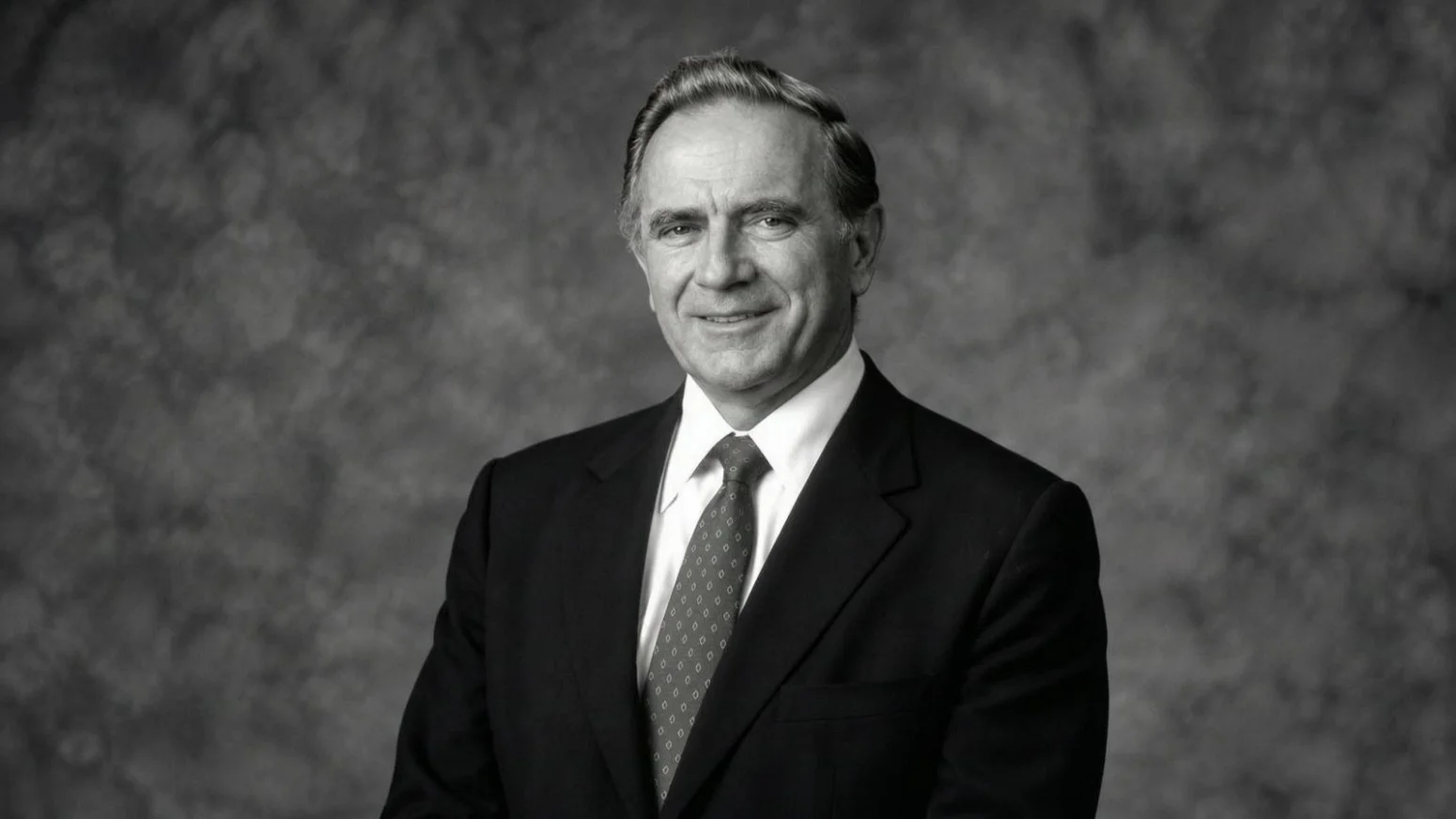
Milan Panić (1929-2026) Serbian Businessman and Politician
Full name: Milan Panić (Милан Панић)
Born: 20 December 1929, Belgrade, Kingdom of Yugoslavia
Died: 24 September 2026 (aged 96), Pasadena, California, U.S.
Cause of death: Natural causes
Occupation: Businessman, humanitarian, politician
Years active: 1959–2026
Known for: Founder of ICN Pharmaceuticals; 1st Prime Minister of FR Yugoslavia
Political party: Independent
Spouses: Jelica Narandžić (m. 1954; died 1976), Sally Taylor (m. 1976; div. 1998), Milena Kitić (m. 2006; div. 2011), Alexandra Novak (m. 2019)
Children: 1
Who Was Milan Panić?
Milan Panić (20 December 1929 – 24 September 2026) was a Serbian businessman, humanitarian, and politician whose life story reads like something out of a novel. He escaped communist Yugoslavia as a young cyclist, built a pharmaceutical empire from his garage in California with just $200, and then returned to his homeland to serve as the first Prime Minister of the Federal Republic of Yugoslavia at one of the darkest moments in Balkan history.
For most of the world, Panić was known as the charismatic CEO who turned ICN Pharmaceuticals into a global giant, developing the antiviral drug ribavirin along the way. But for the people of the former Yugoslavia, he was the man who dared to stand against Slobodan Milošević, campaigned for peace while bombs were still falling, and helped lay the groundwork for the Dayton Accords that ended the Bosnian War.
He passed away in Pasadena, California, on 24 September 2026, at the age of 96. His death was confirmed by Vijesti and other Balkan news outlets. Tributes poured in from business leaders, politicians, and ordinary people whose lives he had touched through his philanthropy and his tireless pursuit of peace.
Milan Panić Cause of Death
Milan Panić died at his home in Pasadena, California, on 24 September 2026, at the age of 96. His death was confirmed by Balkan news outlet Vijesti, which reported that the former prime minister had passed away peacefully. No specific illness was publicly disclosed by his family, and his cause of death was attributed to natural causes related to his advanced age.
Panić had been living a quiet retirement in Southern California in his final years, though he remained active in philanthropic circles and continued to speak about peacebuilding and democracy in the Balkans. He had celebrated his 96th birthday in December 2025 and, despite his age, had maintained an impressive level of engagement with the causes he cared about.
His passing marked the end of an era for the former Yugoslavia. Panić was the last surviving major figure from the early days of the Federal Republic of Yugoslavia's government, and his death prompted an outpouring of remembrance across Serbia, Montenegro, Bosnia, and the wider diaspora. Flags were lowered at several institutions in Belgrade, and former colleagues described him as a man who "loved his people and never stopped fighting for them."
He is survived by his fourth wife, Alexandra Novak, his son from his marriage to Milena Kitić, and a legacy that stretches from the laboratories of Costa Mesa to the negotiating tables of Dayton, Ohio.
Early Life and Childhood in Serbia
Milan Panić was born on 20 December 1929 in Belgrade, Kingdom of Yugoslavia, into a middle-class family. His father was a prominent government official, but tragedy struck early — he died when Panić was only three years old, leaving his mother to raise him and his sisters on her own. It was a difficult childhood, made even harder by the Nazi occupation of Belgrade during World War II.
Faced with a growing shortage of goods, the young Panić started a working vegetable farm to support his family and his community. It was an early sign of the resourcefulness and determination that would define his entire life. As a student, he gravitated toward geography and chemistry, assembling a small laboratory in his room to conduct experiments — a hobby that foreshadowed his future career in pharmaceuticals.
When he was only 14 years old, Panić joined the Yugoslav Partisans to fight the growing Nazi influence in his country. After returning from military service, he resumed his secondary studies in biochemistry at the Belgrade Faculty of Technology. He enrolled as a medical student at the University of Belgrade medical school before transferring to the biochemistry degree program.
Cycling Career
Before he became a businessman or a politician, Milan Panić was a cyclist. He was an avid rider from his youth into early adulthood, and over the course of his cycling career, he rose to become a Yugoslavian national champion. He competed at the international level on prominent teams, including the Yugoslavian national team, and was even an alternate athlete on the nation's Summer Olympic team.
It was while traveling to an international cycling tournament in the Netherlands in 1955 that Panić made the decision that would change his life forever. He defected to Austria with his wife, Jelica Panić (née Narandžić). The couple left behind their homeland, their families, and everything they knew, driven by a desire for freedom and opportunity.
Defection and Refugee Status
After defecting to Austria in August 1955, Panić and his wife applied for asylum in Germany and moved to a West German refugee camp. Life in the camp was difficult, but Panić made the most of it. While in Germany, he enrolled in the PhD program at the University of Heidelberg and worked as a furniture mover to make ends meet.
After receiving asylum in Germany several months later, Panić applied for a program that resettled refugees in the United States. Upon their acceptance, he and Jelica moved to Fontana, California, in early 1956. Panić worked in labs at Kaiser Steel and the University of Southern California, where he also studied biochemistry. By 1959, he was ready to start his own business — and the rest is history.
Business Career
Launch of ICN
In 1959, Milan Panić launched the International Chemical and Nuclear Corporation (ICN) out of his garage just outside Los Angeles, California, using $200 in startup capital. His initial business model was built on synthesizing chemical compounds to sell to California research labs. It was a humble beginning for what would become a pharmaceutical empire.
During the 1960s, ICN marketed a generic version of L-Dopa, a widely used Parkinson's disease treatment. Panić led ICN over the following decades to develop the building blocks for several thousand potential new drugs. As ICN grew, he moved his operations from Pasadena to a new research lab in Costa Mesa and renamed the company ICN Pharmaceuticals. In 1967, ICN was officially listed on the New York Stock Exchange.
Discovery of Ribavirin and Production of Virazole
In 1972, ICN discovered the ribavirin compound, the earliest recorded broad-spectrum antiviral agent. Chemists Joseph T. Witkovski and Ronald K. Robins were integral to the compound's creation. In 1985, ribavirin was approved under the name Virazole by the Food and Drug Administration for the treatment of respiratory syncytial virus (RSV), an upper respiratory tract disease that primarily affects children. In 1991, ICN created the SPAG-2 nebulizer to administer an aerosolized form of ribavirin during hospital treatments.
In 1985, ICN and Eastman-Kodak launched a six-year, $45 million joint venture to research drugs that slow, halt, or reverse the aging process. Between 1986 and 1987, the FDA contended that ICN had exaggerated Virazole's effectiveness in treating other illnesses, including the AIDS virus. ICN settled with the FDA in 1991. In January 1988, ICN acquired 7.3% of Swiss pharmaceutical company Hoffman-La Roche as part of an acquisition strategy to expand its reach.
Following the fall of the Berlin Wall, ICN acquired multiple pharmaceutical firms in Eastern Europe. In May 1991, ICN bought 75% of Galenika, Yugoslavia's largest drug maker at the time. After eight months, the new subsidiary ICN-Galenika was producing revenues of $364 million. In April 1992, ICN Pharmaceuticals and ICN-Galenika partially financed a $100,000 initiative to vaccinate children in the Yugoslav province of Kosovo.
Global Success and End of Tenure at ICN
In 1998, the FDA approved Virazole for the treatment of Hepatitis C in conjunction with another medication called interferon. Virazole eventually became a global standard treatment for multiple pediatric and adult medical conditions, including chronic Hepatitis C, influenza, parainfluenza, adenovirus, measles, Crimean-Congo hemorrhagic fever, and Lassa fever.
During the 1990s, Panić resolved four sexual harassment suits filed by former employees of ICN. In 2002, ICN settled an SEC civil lawsuit related to misleading statements issued regarding their products. Panić decided to retire as CEO and Chairman of ICN in June 2002 after opposing shareholders took control of the board. Over the course of his career, he led ICN to annual sales in 90 countries exceeding $672 million, with over 600 drugs in its portfolio by his final year in 2001. In 2003, after Panić's departure, ICN Pharmaceuticals changed its name to Valeant Pharmaceuticals International.
MP Biomedicals
After retiring from ICN, Panić bought a bioassay subsidiary of ICN Biomedicals and changed its name to MP Biomedicals. The company specializes in research and development of life science and diagnostic products. Its global headquarters is located in Santa Ana, California, with its U.S. headquarters and central distribution center in Solon, Ohio.
On 14 June 2010, Panić and MP acquired ICPBio International LTD., a New Zealand-based protein biologics manufacturing company. On 11 December 2014, the FDA approved MP Diagnostics HTLV Blot 2.4, the first FDA-licensed supplemental test for Human T-cell Lymphotropic Virus-I/II. In October 2015, Panić announced the sale of MP Biomedicals to China-based Valiant Fine Chemicals Co. Ltd.
Political and Public Service in Europe
Prime Minister of Yugoslavia
In July 1992, Milan Panić assumed the position of Prime Minister of the Federal Republic of Yugoslavia at the request of Yugoslav President Dobrica Ćosić and Serbian President Slobodan Milošević. It was an extraordinary moment — an American citizen and successful businessman returning to lead a country that was being torn apart by war and sanctions.
Panić set out with ambitious goals: achieving peace, drafting a constitution, lifting U.N. sanctions, and pushing for the closure of concentration camps. In August 1992, he played a central role in the London International Conference on the Former Yugoslavia, which called for international attention to the country's worsening economic and political situation. At the conference, Panić submitted a twelve-point Plan for Peace. One month later, he delivered a "Speech of Peace" address in front of the United Nations General Assembly.
On 2 December 1992, Panić announced his intention to challenge Milošević for the Serbian presidency, campaigning on a platform of economic reforms and bringing a peaceful resolution to the Bosnian War. He contended that Milošević had crippled Serbia by allowing unemployment and inflation to rise while inciting isolation and sanctions by the international community. Panić appealed directly to Serbian youth and older voters seeking a compromise, including recognition of Croatia and Bosnia-Herzegovina with their current borders.
In the 1992 Serbian general election, Panić came in second behind Milošević, receiving 32% of votes cast. In the aftermath, observers at the Helsinki Commission, political experts, and journalists alleged that Milošević and his supporters had manipulated the election results through improper use of state media and vote tampering. Panić is also remembered as the first civilian to serve as Defence Minister in the history of Serbia.
Yugoslavia Peace Efforts and Dayton Accords
Following his term as prime minister, Panić stayed involved in the effort to restore peace and democracy in the region. In December 1993, he began correspondence with U.S. President Bill Clinton regarding a proposed peace summit with all heads of state of the former Yugoslavia. In 1994, he met with Clinton and his advisers in California to discuss the proposal further.
Following additional discussions over the next two years, in which Panić proposed a Balkans peace conference, the Clinton Administration convened the Conference on Establishing Peace at Wright-Patterson Air Force Base in Dayton, Ohio. The conference culminated in the signing of the Dayton Accords on 21 November 1995, which brought an end to the Bosnian War by dividing Bosnia and Herzegovina into two separate entities: the Federation of Bosnia and Herzegovina and the Republika Srpska. Following the end of the war, Panić continued to push for democracy in the Yugoslav region by convening political activists and advocating in the media.
Personal Life
Philanthropic Contributions
Milan Panić provided philanthropic support to various universities, research programs, museums, political causes, and charities through both his Milan Panić Jr. Foundation and MP Global Enterprises & Associates, LLC. He supported the Muscular Dystrophy Association and sponsored scholarships at the MIT-Harvard Medical School Program. He lectured frequently on peacebuilding at George Washington University, the University of Southern California, and Chapman University, where he was a member of the President's cabinet.
He provided support to the Freedoms Foundation in Valley Forge, Pennsylvania, penning the Bill of Responsibilities and donating a Bill of Responsibilities Monument to their headquarters in 1990. He was a frequent supporter of California cultural institutions, including the Los Angeles Opera, where he served as a Vice Chairman and sponsored season-opening performances from 2002 onward. He also provided charitable support to the City of Hope Cancer Research and Treatment Center.
Family and Death
Milan Panić was married four times. His first wife was Jelica Narandžić, whom he married in 1954 and who died in 1976. He then married Sally Taylor in 1976 and they divorced in 1998. In 2006, he married Milena Kitić, a mezzo-soprano opera singer, and they later divorced. Together they had a son. In 2019, he married Alexandra Novak.
Panić died in Pasadena, California, on 24 September 2026, at the age of 96. His death was confirmed by Vijesti and other Balkan news outlets. He was remembered as a man of extraordinary vision, generosity, and courage — someone who never forgot where he came from and spent his entire life giving back.
Awards and Recognition
Milan Panić received numerous honors throughout his long career in business, politics, and philanthropy.
- Ellis Island Medal of Honor (1986) — awarded by the Statue of Liberty-Ellis Island Foundation on 27 October 1986.
- "European of the Year" (1992) — awarded by the Wall Street Journal Europe for his efforts as Yugoslav Prime Minister to introduce democratic, free-market reforms, bring peace, and galvanize opposition to Slobodan Milošević.
- Chamber Global Award (2002) — presented by the Chamber of Commerce Belgium-Luxembourg South-Eastern Europe in Brussels on 17 December 2002.
- Lifetime Achievement Award (2015) — awarded by the Lifeline Humanitarian Organization of New York in February 2015 for his philanthropic support of academic, cultural, political, and relief organizations around the world.
Career Highlights
Milan Panić's career spanned more than six decades and touched nearly every sector of public life. Here are some of the most significant milestones from his remarkable journey.
| Year | Milestone | Details |
|---|---|---|
| 1955 | Defected to Austria | Left Yugoslavia during an international cycling tournament with his wife Jelica. |
| 1956 | Moved to the United States | Resettled in Fontana, California, through a refugee program. |
| 1959 | Founded ICN | Launched International Chemical and Nuclear Corporation with $200 in his garage. |
| 1967 | ICN Listed on NYSE | Company went public on the New York Stock Exchange. |
| 1972 | Discovered Ribavirin | ICN discovered the earliest recorded broad-spectrum antiviral agent. |
| 1985 | Virazole Approved | FDA approved ribavirin under the name Virazole for RSV treatment. |
| 1991 | Acquired Galenika | ICN bought 75% of Yugoslavia's largest drug maker. |
| 1992 | Became Prime Minister | Appointed Prime Minister of the Federal Republic of Yugoslavia. |
| 1992 | Ran for Serbian President | Came in second behind Slobodan Milošević with 32% of votes. |
| 1995 | Dayton Accords Signed | His peace efforts contributed to ending the Bosnian War. |
| 2002 | Retired from ICN | Stepped down as CEO and Chairman after opposing shareholders took control. |
| 2003 | Founded MP Biomedicals | Bought an ICN subsidiary and renamed it MP Biomedicals. |
| 2015 | Sold MP Biomedicals | Announced sale to China-based Valiant Fine Chemicals Co. Ltd. |
| 2026 | Died at 96 | Passed away peacefully in Pasadena, California. |
Tributes and Legacy
Following the announcement of Milan Panić's death, tributes poured in from across the world. Business leaders remembered him as a visionary entrepreneur who built something extraordinary from nothing. Politicians remembered him as a courageous leader who stood up to Milošević when it was dangerous to do so. And ordinary people remembered him as a generous philanthropist who never forgot his roots.
In Belgrade, flags were lowered at several institutions, and former colleagues described him as a man who "loved his people and never stopped fighting for them." In California, where he spent most of his adult life, cultural and charitable organizations that he had supported for decades issued statements of gratitude and remembrance.
Panić's legacy is multifaceted. In the world of medicine, he is remembered for his role in developing ribavirin, a drug that has saved countless lives. In the world of business, he is remembered as the immigrant who built a global pharmaceutical company from a garage. And in the world of politics, he is remembered as the man who tried to stop a war — and who played a part in ending one.
Conclusion: Remembering Milan Panić
Milan Panić was a man of many lives. He was a child of war-torn Belgrade, a teenage partisan, a champion cyclist, a refugee, a self-made billionaire, a prime minister, a peacemaker, and a philanthropist. Few people in modern history have packed so much into a single lifetime.
His death on 24 September 2026, at the age of 96, marked the end of a remarkable journey that began in a middle-class home in Belgrade and ended in a peaceful home in Pasadena, California. Along the way, he founded a pharmaceutical empire, developed a life-saving drug, led a nation, and helped bring an end to one of the most brutal conflicts in European history.
As the world mourns his passing, it also celebrates a life that was, in every sense of the word, extraordinary. Milan Panić will be deeply missed, but his legacy — in medicine, in business, in politics, and in philanthropy — will live on for generations to come.
Frequently Asked Questions: Milan Panić
Who was Milan Panić?
Milan Panić (20 December 1929 – 24 September 2026) was a Serbian businessman, humanitarian, and politician. He served as the first Prime Minister of the Federal Republic of Yugoslavia from 1992 to 1993 and was also the country's first civilian Minister of Defence. Before entering politics, he founded ICN Pharmaceuticals and built it into a global corporation listed on the New York Stock Exchange.
How did Milan Panić die?
Milan Panić died in Pasadena, California, on 24 September 2026, at the age of 96. His death was confirmed by news outlets in the Balkans, including Vijesti. He passed away peacefully, surrounded by his family, after living a long and remarkable life that spanned business, politics, and philanthropy.
What was Milan Panić's cause of death?
Milan Panić died of natural causes at his home in Pasadena, California, on 24 September 2026, at the age of 96. No specific illness was publicly disclosed by his family. He had been in declining health due to his advanced age and passed away peacefully.
What was Milan Panić famous for?
Milan Panić was famous for two major achievements. First, he founded ICN Pharmaceuticals in 1959 with just $200 and grew it into a global corporation with over $672 million in annual sales across 90 countries. Second, he served as the first Prime Minister of the Federal Republic of Yugoslavia from 1992 to 1993, where he campaigned for peace and democracy in the Balkans.
Where was Milan Panić born?
Milan Panić was born on 20 December 1929 in Belgrade, Kingdom of Yugoslavia (present-day Serbia). He was born into a middle-class family. His father, a prominent government official, died when Panić was only three years old, leaving his mother to raise him and his sisters.
Was Milan Panić a cyclist?
Yes, Milan Panić was an avid cyclist from his youth into early adulthood. He rose to become a Yugoslavian national champion and competed at the international level. He was also an alternate athlete on Yugoslavia's Summer Olympic team. While traveling to an international cycling tournament in the Netherlands in 1955, he defected to Austria with his wife Jelica.
How did Milan Panić start ICN Pharmaceuticals?
Milan Panić launched the International Chemical and Nuclear Corporation (ICN) in 1959 out of his garage just outside Los Angeles, California, using only $200 in startup capital. His initial business model was built on synthesizing chemical compounds to sell to California research labs. In 1967, ICN was officially listed on the New York Stock Exchange.
What is ribavirin and how is Milan Panić connected to it?
Ribavirin is the earliest recorded broad-spectrum antiviral agent, discovered by ICN in 1972. Chemists Joseph T. Witkovski and Ronald K. Robins were integral to its creation. In 1985, ribavirin was approved under the name Virazole by the FDA for treating respiratory syncytial virus (RSV). Virazole later became a global standard treatment for Hepatitis C and other viral conditions.
When was Milan Panić Prime Minister of Yugoslavia?
Milan Panić served as Prime Minister of the Federal Republic of Yugoslavia from 14 July 1992 to 9 February 1993. He was also the first Minister of Defence of FR Yugoslavia, serving from 14 July 1992 to 2 March 1993. He was appointed at the request of Yugoslav President Dobrica Ćosić and Serbian President Slobodan Milošević.
Did Milan Panić run for President of Serbia?
Yes, on 2 December 1992, Milan Panić announced his intention to challenge Slobodan Milošević for the Serbian presidency. He campaigned on a platform of economic reforms and a peaceful resolution to the Bosnian War. In the 1992 Serbian general election, Panić came in second behind Milošević, receiving 32% of the votes.
What was Milan Panić's role in the Dayton Accords?
Following his term as prime minister, Milan Panić stayed involved in peace efforts. In December 1993, he began correspondence with U.S. President Bill Clinton about a proposed peace summit. In 1994, he met with Clinton to discuss the proposal. These discussions eventually led to the Conference on Establishing Peace at Wright-Patterson Air Force Base in Dayton, Ohio, which culminated in the Dayton Accords on 21 November 1995.
What was MP Biomedicals?
After retiring from ICN, Milan Panić bought a bioassay subsidiary of ICN Biomedicals and renamed it MP Biomedicals. The company specializes in research and development of life science and diagnostic products. Its global headquarters is in Santa Ana, California. In October 2015, Panić announced the sale of MP Biomedicals to China-based Valiant Fine Chemicals Co. Ltd.
What awards did Milan Panić receive?
Milan Panić received the Ellis Island Medal of Honor in 1986. He was named 'European of the Year' in 1992 by the Wall Street Journal Europe. He was presented the Chamber Global Award in Brussels in 2002. In February 2015, the Lifeline Humanitarian Organization awarded him a lifetime achievement award for his philanthropic support.
How many times was Milan Panić married?
Milan Panić was married four times. His first wife was Jelica Narandžić, whom he married in 1954 and who died in 1976. He then married Sally Taylor in 1976 and they divorced in 1998. In 2006, he married Milena Kitić, a mezzo-soprano opera singer, and they later divorced. In 2019, he married Alexandra Novak.
Did Milan Panić have children?
Yes, Milan Panić had a son with his third wife, Milena Kitić, a mezzo-soprano opera singer. He was a devoted father and family man. He kept his personal life relatively private while remaining active in philanthropy and public service.
What was Milan Panić's connection to Chapman University?
Milan Panić was a member of the President's cabinet at Chapman University. He lectured frequently on peacebuilding at George Washington University, the University of Southern California, and Chapman University. He also sponsored scholarships at the MIT-Harvard Medical School Program and supported various educational initiatives.
Contents
- Who Was Milan Panić
- Cause of Death
- Early Life and Childhood
- Cycling Career
- Defection and Refugee Status
- Business Career
- Political and Public Service
- Personal Life
- Awards and Recognition
- Career Highlights
- Tributes and Legacy
- Conclusion
- FAQs (16+ Questions)
Data Update
Based on Vijesti, Wikipedia, The New York Times, Los Angeles Times, and other public sources. Information about his death may change as more details become available.