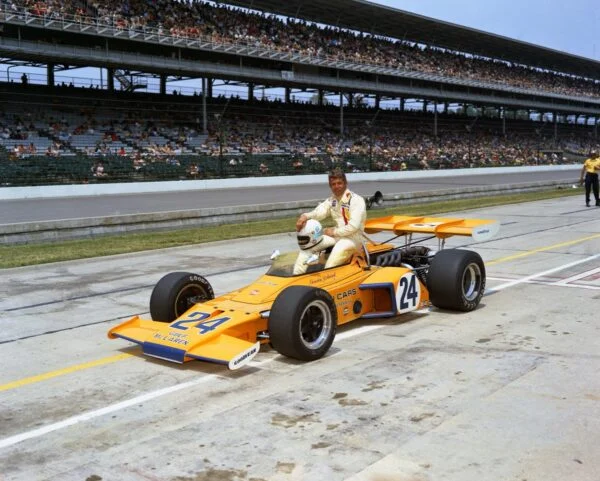
Gordon Johncock (1937-2026) American Racing Driver
Full name: Gordon Walter Johncock
Born: August 5, 1936, Hastings, Michigan, U.S.
Died: September 28, 2026 (aged 90), South Branch, Michigan, U.S.
Cause of death: Natural causes
Championships: USAC Championship Car (1976)
Major wins: Indianapolis 500 (1973, 1982), Michigan 500 (1982)
Spouse: Sue Johncock
Who Was Gordon Johncock?
Gordon Walter Johncock (August 5, 1936 – September 28, 2026) was an American racing driver and one of the most respected figures in American open-wheel racing. He was a two-time winner of the Indianapolis 500, capturing the checkered flag in 1973 and 1982, and was the 1976 USAC Championship Car national champion. Over a career that spanned 26 years and 262 starts, he established himself as one of the most skilled and versatile drivers of his era.
Known affectionately as "Gordy" by fans and fellow drivers, Johncock was a lifelong Michigan resident. He was born in Hastings, Michigan, and began his racing career on local dirt tracks before rising to the highest levels of American motorsports. His quiet, unassuming personality off the track contrasted sharply with his fierce, determined driving style on it.
Johncock passed away on September 28, 2026, at his home in South Branch, Michigan, at the age of 90. His family announced that he died of natural causes. He is survived by his wife Sue, six children, 12 grandchildren, 17 great-grandchildren, and one great-great-grandchild — a remarkable legacy both on and off the track.
Gordon Johncock Cause of Death
Gordon Johncock died of natural causes on Monday, September 28, 2026, at his home in South Branch, Michigan. He was 90 years old. His family announced his passing, confirming that he died peacefully at home.
Johncock had been in good health in the years leading up to his death and remained active with his timber business in Michigan. He had no known serious illness and passed away quietly surrounded by his family. His death marks the end of an era for American open-wheel racing, as he was one of the last surviving stars of the sport's golden age in the 1960s and 1970s.
Tributes poured in from across the motorsports world following the announcement. Fellow drivers, team owners, and fans remembered him not only for his incredible racing achievements but also for his humility and integrity. The Indianapolis Motor Speedway released a statement honoring his legacy, noting that his 1982 victory remains one of the most iconic moments in the race's history.
Early Life and Racing Beginnings
Gordon Walter Johncock was born on August 5, 1936, in Hastings, Michigan. He grew up in a working-class family and developed a passion for speed and competition at a young age. His early racing career began at local Michigan tracks, including the Old Hastings Raceway, Capital City Speedway in Lansing, the Grand Rapids Speedrome, and later at Berlin Raceway in Marne.
In 1963, Johncock won the inaugural National Open sprint car race at Williams Grove Speedway in Pennsylvania, a victory that caught the attention of team owners across the country. His talent and determination were evident from the start, and it was only a matter of time before he made the jump to the national stage.
Johncock's breakthrough came in 1964 when he signed with Weinberger Racing to compete in the USAC and CART/IndyCar series. He ran four races that year and went full-time in 1965. His first USAC victory came at the Milwaukee Mile in August 1965, signaling the arrival of a future star.
Racing Career
Gordon Johncock's racing career spanned nearly three decades and included some of the most memorable moments in American motorsports history. Here is a detailed look at his journey through the ranks.
Early USAC Years (1964–1972)
After going full-time in 1965, Johncock quickly established himself as a consistent front-runner. In 1966, he finished fourth at the Indianapolis 500 and third in the USAC championship standings. Despite going winless in nine starts that year, his talent was undeniable.
At the end of 1966, Johncock left Gerhardt Racing to form his own team, Johncock Racing. His primary sponsor became Gilmore Broadcasting, and he became one of only two "owner-drivers" in IndyCar, alongside the legendary A.J. Foyt. His team won six races between 1967 and 1969, but things took a turn for the worse when he lost the Gilmore sponsorship at the end of 1970.
Between 1970 and 1973, Johncock went winless, his team shut down, and he found himself in bankruptcy court. It was the lowest point of his career, but it would not define him.
The 1973 Indianapolis 500 Victory
Johncock's fortunes changed when he joined the STP/Patrick Racing team ahead of the 1973 USAC season. The 1973 Indianapolis 500 would become one of the most tragic and emotionally complex races in the event's history.
A major accident at the start involving Salt Walther injured several spectators, and two days of rain postponed the race until late Wednesday afternoon. When the race resumed, Johncock's teammate Swede Savage was severely injured in a fiery crash on lap 58. A moment later, Armando Teran, a pit crew member on the same STP/Patrick team, was struck by a fire truck and fatally injured.
When the race resumed, Johncock took the lead on lap 73 and held it until rain fell again on lap 133. The race was red-flagged and declared over. After a short and muted victory lane celebration, Johncock went to visit Savage at the hospital. The celebratory victory banquet was cancelled, and instead, Johncock and his crew went to a local fast-food restaurant for hamburgers. Thirty-three days after the race, Savage succumbed to his injuries.
USAC Championship (1976)
Johncock won the USAC national championship in 1976, snatching the title from Johnny Rutherford in the final race of the season at Phoenix International Raceway. It was the crowning achievement of his career and cemented his place among the sport's elite.
In 1976 and 1978, he finished third in the Indianapolis 500, and in 1977, he was leading A.J. Foyt when his car's crankshaft broke with sixteen laps to go. He had led 129 laps of that race.
The 1982 Indianapolis 500: A Legendary Duel
Johncock's second Indianapolis 500 victory in 1982 is considered one of the greatest finishes in the history of the race. He beat Rick Mears by just 0.16 seconds — the closest finish in Indy 500 history at the time and still the fifth-closest ever.
After falling behind on the final sequence of pit stops, Mears rapidly closed in on Johncock in the final laps. On laps 197 and 198, Mears came from three seconds back to within a car length. Johncock's tires were rapidly deteriorating, and with each turn, the car understeered severely.
Mears caught Johncock at the start of the final lap and tried to pass him for the win, but Johncock made a decisive defense of his position in Turn One and held on to win. Mears later joked about watching the race over and over "to see if this time I get around Gordy." Johncock, years later, offered that if the duel had occurred two or three years later — when Mears had more experience — the Californian would probably have pulled off the winning pass.
Later Career and Retirement
Johncock took another three IndyCar races, including the 1982 Michigan 500, before retiring from full-time racing in 1985. He returned for occasional appearances in 1987, 1988, 1989, 1991, and finally retired for good after the 1992 Indianapolis 500.
His last IndyCar win was in the opening round of the 1983 CART PPG Indy Car World Series at the Atlanta Motor Speedway. Driving a Cosworth-powered Patrick Wildcat, he started third and won the 200-mile, 132-lap race with an average speed of 146.133 mph.
NASCAR Career
Johncock also competed in 21 NASCAR Sprint Cup Series events during his career. He earned three top-fives and four top-tens in his limited schedule. His best finishes were a pair of fourths in 1973 at Daytona and in 1966 at Rockingham. He also raced in the International Race of Champions (IROC) series multiple times.
Gordon Johncock Career Statistics
| Category | Statistics |
|---|---|
| IndyCar Starts | 262 races over 26 years |
| IndyCar Wins | 25 |
| IndyCar Podiums | 76 |
| IndyCar Poles | 20 |
| Indianapolis 500 Starts | 24 (5th all-time, tied with Johnny Rutherford and Scott Dixon) |
| Indianapolis 500 Wins | 2 (1973, 1982) |
| Indianapolis 500 Laps Led | 339 (15th all-time) |
| USAC Championship | 1976 |
| NASCAR Starts | 21 |
| NASCAR Top 5s | 3 |
| NASCAR Top 10s | 4 |
Indianapolis 500 Results
Gordon Johncock made 24 starts in the Indianapolis 500, one of the most prestigious races in the world. Here is a look at his complete Indy 500 history.
| Year | Start | Finish | Team |
|---|---|---|---|
| 1965 | 14 | 5 | Weinberger & Welseck |
| 1966 | 6 | 4 | Weinberger & Welseck |
| 1967 | 3 | 12 | Johncock Racing |
| 1968 | 9 | 27 | Johncock Racing |
| 1969 | 5 | 19 | Johncock Racing |
| 1970 | 17 | 28 | Johncock Racing |
| 1971 | 12 | 29 | Vollstedt Enterprises |
| 1972 | 26 | 20 | Team McLaren |
| 1973 | 11 | 1 | Patrick Racing |
| 1974 | 4 | 4 | Patrick Racing |
| 1975 | 2 | 31 | Patrick Racing |
| 1976 | 2 | 3 | Patrick Racing |
| 1977 | 5 | 11 | Patrick Racing |
| 1978 | 6 | 3 | Patrick Racing |
| 1979 | 5 | 6 | Patrick Racing |
| 1980 | 17 | 4 | Patrick Racing |
| 1981 | 17 | 9 | Patrick Racing |
| 1982 | 5 | 1 | Patrick Racing |
| 1983 | 10 | 14 | Patrick Racing |
| 1984 | 5 | 25 | Patrick Racing |
| 1987 | 18 | 22 | Patrick Racing |
| 1988 | DNQ | - | Royal Motor Racing |
| 1989 | 23 | 31 | Hemelgarn Racing |
| 1991 | 33 | 6 | Hemelgarn Racing |
| 1992 | 30 | 29 | Hemelgarn Racing |
Awards and Honors
Gordon Johncock received numerous honors throughout his career and after his retirement. His contributions to American motorsports were recognized by multiple halls of fame.
- Michigan Motorsports Hall of Fame — Inducted 1985
- Indianapolis Motor Speedway Hall of Fame — Inducted 1997
- International Motorsports Hall of Fame — Inducted 1999
- Grand Rapids Sports Hall of Fame — Inducted 2000
- Motorsports Hall of Fame of America — Inducted 2002
- United States Auto Club Hall of Fame — Inducted 2025
In 2023, during the lead-up to the Indianapolis 500, officials from Borg-Warner invited Johncock back to Indianapolis to celebrate the 50th anniversary of his 1973 win. Johncock and his extended family took a ceremonial lap around the Speedway in a tour bus. After stopping for pictures at the Yard of Bricks, Johncock got into the driver's seat of the bus and took his family for an impromptu second and final lap around the track.
Personal Life and Legacy
Gordon Johncock was a lifelong Michigan resident. After retiring from racing, he distanced himself from motorsports and focused on his timber business in South Branch, Michigan. He participated in a 2004 ESPN Classic interview about the 1982 Indy 500, where he admitted that his interest in racing had diminished and that farming was what he had always been "caring to do."
Johncock chose not to attend the 2011 Indianapolis 500, which celebrated the 100th anniversary of the first race, despite the fact that all living former participants were invited. A year later, Speedway officials again invited him to attend the 2012 Indianapolis 500, and this time he returned to the Speedway and participated in pre-race festivities.
He is survived by his wife Sue, six children, 12 grandchildren, 17 great-grandchildren, and one great-great-grandchild. His family described him as a devoted husband, father, and grandfather who always put family first.
Conclusion: Remembering Gordon Johncock
Gordon Johncock was one of the greatest American racing drivers of his generation. His two Indianapolis 500 victories, his 1976 USAC championship, and his 25 career wins are testaments to his skill and determination. But beyond the statistics, he was remembered for his humility, his integrity, and his devotion to his family.
His death on September 28, 2026, at the age of 90, marked the end of an era in American motorsports. He died of natural causes at his home in South Branch, Michigan, surrounded by his loved ones. His legacy lives on through his family, his fans, and the countless drivers he inspired.
As the racing world mourns his passing, it also celebrates a life well-lived — one that began on the dirt tracks of Michigan and ended as a two-time Indianapolis 500 champion and a beloved American icon.
Frequently Asked Questions: Gordon Johncock
Who was Gordon Johncock?
Gordon Walter Johncock (August 5, 1936 – September 28, 2026) was an American racing driver. He won the Indianapolis 500 in 1973 and 1982 and was the 1976 USAC Championship Car champion. He also won the Michigan 500 in 1982. He was inducted into the Indianapolis Motor Speedway Hall of Fame in 1997 and the International Motorsports Hall of Fame in 1999.
How did Gordon Johncock die?
Gordon Johncock died of natural causes on Monday, September 28, 2026, at his home in South Branch, Michigan. He was 90 years old. His family announced his passing. He had been a lifelong Michigan resident and spent his retirement years focused on his timber business.
What was Gordon Johncock's cause of death?
Gordon Johncock died of natural causes. He passed away peacefully at his home in South Branch, Michigan, on September 28, 2026, at the age of 90. His family confirmed the cause of death was natural. He had no known serious illness prior to his death.
How many Indianapolis 500 races did Gordon Johncock win?
Gordon Johncock won the Indianapolis 500 twice — in 1973 and 1982. His 1973 win came in a rain-shortened race that was delayed two days. His 1982 win was famous for its dramatic closing-lap duel with Rick Mears, which he won by just 0.16 seconds, the closest finish in Indy 500 history at the time.
What was Gordon Johncock's most famous race?
Gordon Johncock's most famous race was the 1982 Indianapolis 500. He beat Rick Mears by just 0.16 seconds in a dramatic closing-lap duel. The finish was the closest in Indy 500 history at the time and remains the fifth-closest finish ever. Mears later joked about watching the race over and over to see if he could get around Gordy.
How many IndyCar races did Gordon Johncock win?
Gordon Johncock made 262 starts during 25 seasons in the IndyCar series. He won 25 races, finished on the podium 76 times, and earned 20 poles. He was the USAC national champion in 1976, winning the title in the final race of the season at Phoenix International Raceway.
Where was Gordon Johncock born?
Gordon Walter Johncock was born on August 5, 1936, in Hastings, Michigan. He began racing at local Michigan tracks like Capital City Speedway in Lansing, the Grand Rapids Speedrome, and Berlin Raceway in Marne. He was a lifelong Michigan resident.
When did Gordon Johncock start his racing career?
Gordon Johncock began his USAC and CART/IndyCar career in 1964 when he drove for Weinberger Racing. He ran four races in 1964 and went full-time in 1965. His first USAC victory came at the Milwaukee Mile in August 1965. He retired permanently after the 1992 Indianapolis 500.
What did Gordon Johncock do after retiring from racing?
After retiring from racing, Gordon Johncock distanced himself from motorsports and focused on his timber business in South Branch, Michigan. He participated in a 2004 ESPN Classic interview about the 1982 Indy 500. He returned to the Speedway in 2012 for the 100th anniversary celebration and again in 2023 for the 50th anniversary of his 1973 win.
What awards did Gordon Johncock receive?
Gordon Johncock was inducted into the Michigan Motorsports Hall of Fame in 1985, the Indianapolis Motor Speedway Hall of Fame in 1997, the International Motorsports Hall of Fame in 1999, the Grand Rapids Sports Hall of Fame in 2000, the Motorsports Hall of Fame of America in 2002, and the United States Auto Club Hall of Fame in 2025.
Was Gordon Johncock married?
Yes, Gordon Johncock was married to his wife Sue. He is survived by his wife, six children, 12 grandchildren, 17 great-grandchildren, and one great-great-grandchild. He passed away at his home in South Branch, Michigan, surrounded by his family.
Did Gordon Johncock race in NASCAR?
Yes, Gordon Johncock competed in 21 NASCAR Sprint Cup Series events in his career. He earned three top-fives and four top-tens in his limited schedule. His best finishes were a pair of fourths in 1973 at Daytona and in 1966 at Rockingham. He also raced in the International Race of Champions.
What was Gordon Johncock's final race?
Gordon Johncock's final race was the 1992 Indianapolis 500, where he dropped out on Lap 60 with engine failure. He finished 29th. His final IndyCar win was in 1983 at the Atlanta Motor Speedway driving a Cosworth-powered Patrick Wildcat, where he averaged 146.133 mph.
What was the 1973 Indianapolis 500 like for Gordon Johncock?
The 1973 Indianapolis 500 was rain-delayed by two days and marred by tragedy. A major accident on the start involving Salt Walther injured several spectators, and Johncock's teammate Swede Savage was severely injured in a fiery crash on lap 58. A pit crew member, Armando Teran, was fatally injured. Johncock won the race when it was red-flagged on lap 133 due to rain. The victory banquet was cancelled out of respect.
Contents
- Who Was Gordon Johncock
- Cause of Death
- Early Life & Racing Beginnings
- Racing Career
- Career Statistics
- Indianapolis 500 Results
- Awards and Honors
- Personal Life and Legacy
- Conclusion
- FAQs (14+ Questions)
Data Update
Based on family announcements, Detroit News, IndyStar, Motorsport, and Wikipedia. Information about his death may change as more details become available.