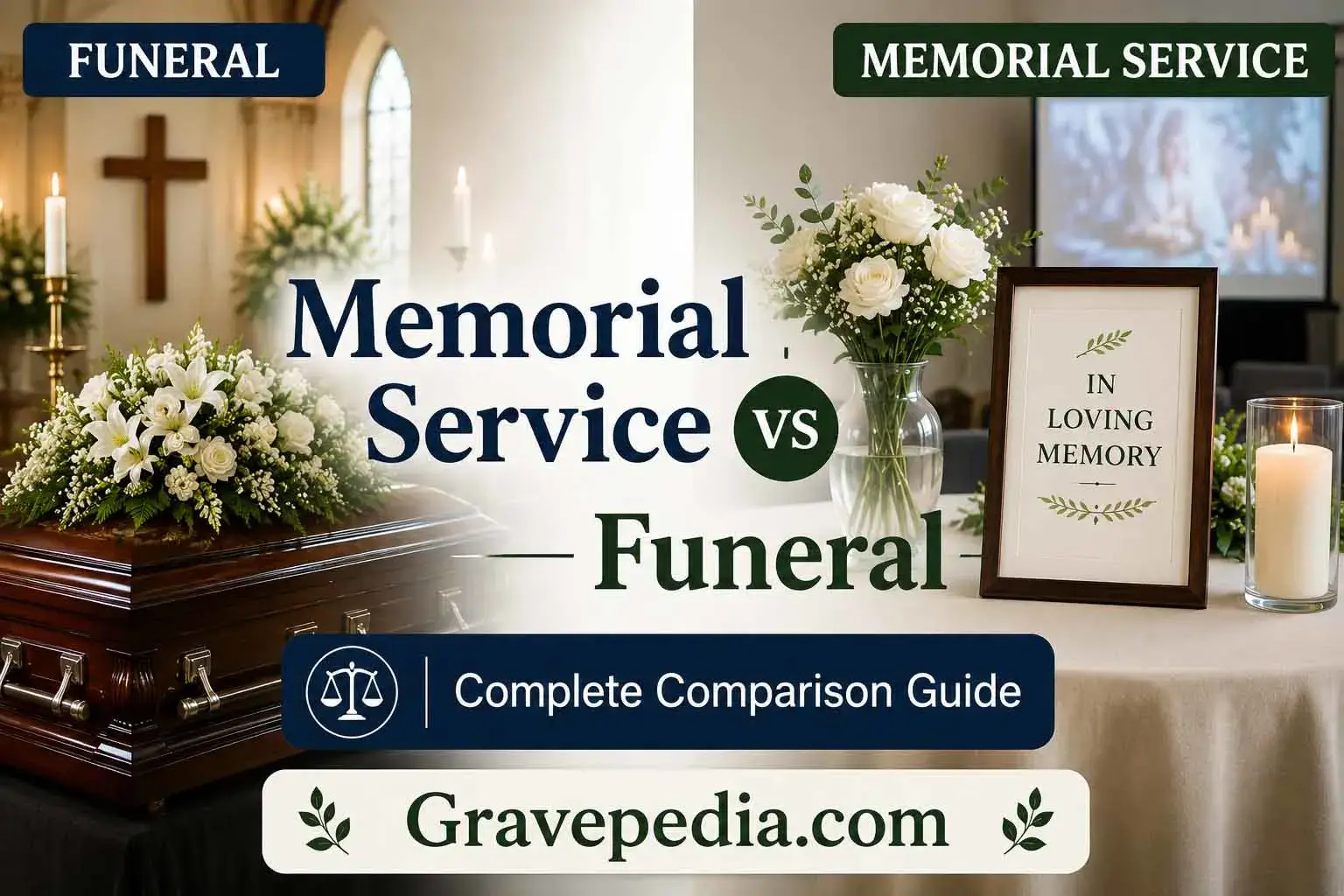
Memorial Service vs Funeral: Complete Comparison Guide
Memorial service vs funeral: Main difference - body presence (memorial has NO body, funeral HAS body in casket)
Memorial service cost: $1,000 - $5,000 (no casket, no embalming, no hearse)
Funeral cost: $7,000 - $12,000 (includes casket, embalming, hearse, viewing)
Celebration of life vs funeral: Uplifting tone vs mourning - can be held weeks later
Which is right for you? Depends on budget, religious beliefs, and family preferences
Memorial Service vs Funeral: What's the Main Difference?
When a loved one passes away, families face many decisions. One of the first questions is whether to have a funeral or a memorial service. The simplest answer to what is a memorial service vs funeral comes down to one thing: the presence of the body. A funeral always has the body present in a casket. A memorial service happens after the body has been cremated or buried, so no body is present. This fundamental difference affects everything else - cost, timing, formality, and emotional tone. In this comprehensive guide, I'll break down every difference between funeral vs memorial, including costs, timing, religious considerations, and how to choose what's right for your family. Whether you're planning ahead or making arrangements after a death, this guide will help you understand your options.
Quick Comparison: Memorial Service vs Funeral
What Is a Funeral? (Traditional Funeral Service)
A traditional funeral is a ceremony where the deceased's body is present, usually in a casket. The body may be embalmed and dressed for viewing. Funeral vs burial service - sometimes people confuse these, but a funeral typically includes a ceremony (at a funeral home or church) followed by a graveside committal service. A traditional funeral usually happens within 3-7 days of death. It includes elements like visitation (viewing), a formal ceremony with speakers and music, and transportation to the cemetery. Funerals often follow religious traditions - Catholic funerals include a funeral mass, Jewish funerals happen within 24 hours, and Muslim funerals also happen quickly.
What's Included in a Traditional Funeral:
- Removal and transportation of the body
- Embalming and body preparation
- Dressing and casketing
- Visitation/viewing (usually 2-4 hours)
- Funeral ceremony (with officiant, music, readings)
- Hearse transportation to cemetery
- Graveside committal service
- Casket (prices range from $1,500 to $10,000+)
What Is a Memorial Service?
A memorial service is a ceremony that honors a deceased person WITHOUT the body present. The body may have been cremated (with ashes in an urn or scattered) or buried in a private ceremony earlier. Is a memorial the same as a funeral? No - the key difference is the absence of the body. Memorial services can be held weeks or even months after death, giving families time to plan without rushing. Memorial service vs funeral service - both honor the deceased, but memorial services are often less formal, less expensive, and more flexible. You can hold a memorial service at a funeral home, church, community center, park, beach, or private home.
What's Included in a Memorial Service:
- Venue rental (optional - home or park may be free)
- Officiant or celebrant (to lead the ceremony)
- Music (recorded or live musicians)
- Readings, poems, or prayers
- Eulogies from family and friends
- Photo slideshow or video tribute
- Memorial table with photos and mementos
- Guest book for attendees to sign
- Optional urn display (if cremated remains are present)
What Is a Celebration of Life?
Celebration of life vs funeral - this is where the tone shifts dramatically. A celebration of life focuses on celebrating the person's life rather than mourning their death. Like a memorial service, no body is present. But unlike a traditional memorial, the atmosphere is uplifting, joyful, and often casual. Think bright colors instead of black, favorite music instead of somber hymns, and happy stories instead of sad eulogies. What is a celebration of life vs funeral - the difference is both tone and format. Celebrations of life are often held at homes, parks, beaches, or restaurants. They may include the person's favorite foods, dancing, or even outdoor activities they loved. Memorial vs celebration of life - a memorial is still somewhat formal and respectful, while a celebration of life is intentionally joyful.
Wake vs Funeral vs Memorial: Understanding All Three
Wake vs funeral service - a wake (also called visitation or viewing) is a time for family and friends to gather, view the body, and offer condolences. Wakes are typically held the evening before the funeral and last 2-4 hours. They are less formal than funerals. Funeral vs wake vs memorial - a funeral is the formal ceremony with the body; a wake is the informal gathering before; a memorial is a ceremony without the body. Memorial vs funeral vs wake - some families have all three: wake (evening before), funeral (next day), and then a memorial service weeks later for out-of-town guests. Funeral visitation vs service - visitation is the time to see the body and pay respects; the service is the formal ceremony.
Cost Comparison: Memorial Service vs Funeral
One of the biggest differences when comparing funeral cost vs cremation (which often leads to a memorial service) is the price. Let me break down the actual costs:
Traditional Funeral Costs ($7,000 - $12,000+):
- Basic services fee: $2,000 - $5,000 (non-negotiable)
- Embalming: $500 - $1,500
- Casket: $1,500 - $10,000+ (average $2,500)
- Viewing/visitation: $400 - $1,000
- Funeral ceremony: $500 - $2,000
- Hearse: $300 - $500
- Flower car/other vehicles: $150 - $400
- Graveside service: $200 - $500
Memorial Service Costs ($1,000 - $5,000):
- Venue rental: $0 - $1,000 (home is free, funeral home chapel $500-$1,500)
- Officiant/celebrant: $200 - $500
- Urn (if ashes present): $100 - $500
- Memorial printing (programs, photos): $50 - $200
- Flowers: $100 - $400
- Refreshments: $100 - $500
- Music/slideshow: $0 - $300
Timing Differences: When Each Service Happens
Funeral vs memorial timing: Traditional funerals must happen within days of death because the body is present. Without embalming, decomposition begins quickly. Even with embalming, the body is typically preserved for only 3-7 days. Memorial services have no time constraints - they can happen weeks or months after death. This flexibility is a major advantage for families with out-of-town relatives who need travel time. Some families hold a small private funeral or direct cremation right after death, then plan a larger memorial service or celebration of life for 2-6 months later when everyone can attend.
Religious Considerations: What Faiths Require
What is a memorial service vs funeral in different religions?
- Catholic: Requires a funeral mass with body present. Memorial masses (without body) are also allowed but less common.
- Jewish: Burial must happen within 24 hours. Memorial services (unveiling) happen 11-12 months later.
- Muslim: Burial happens as quickly as possible (within 24 hours). Memorial services are not traditional.
- Hindu: Cremation happens within 24 hours. Memorial ceremonies (Shraddha) happen later.
- Buddhist: Both funerals and memorial services common, with ceremonies at 3, 7, 49, and 100 days.
- Protestant/Non-denominational: Flexible - both options accepted.
How to Choose: Memorial Service vs Funeral
Is a memorial the same as a funeral in terms of honoring? No, but both are valid. Here's how to decide which is right for your family:
Choose a Traditional Funeral If:
- Religious or cultural traditions require the body present
- Family members need the closure of seeing the body
- Budget allows for higher costs ($7,000-$12,000)
- You want a formal, structured ceremony
- Most attendees live locally (no travel delays)
Choose a Memorial Service If:
- You want to save money ($1,000-$5,000 vs $7,000-$12,000)
- The person was cremated (which is over 60% of cases now)
- You need time to plan (weeks or months after death)
- Out-of-town relatives need travel time
- You prefer a less formal atmosphere
Choose a Celebration of Life If:
- The person was joyful, fun-loving, and would want a party
- You want an uplifting, positive experience for guests
- You want to focus on happy memories rather than mourning
- You have a lower budget ($500 - $3,000)
- You want a casual, unstructured gathering
Conclusion: Memorial Service vs Funeral - Which Is Right for You?
After reading this guide, you now understand the key differences between memorial service vs funeral. Remember the main distinction: funerals have the body present; memorial services do not. This affects cost (memorials are cheaper), timing (memorials can be weeks or months later), and tone (celebration of life events are uplifting and joyful). What is a memorial service vs a funeral service ultimately comes down to your family's needs, budget, religious requirements, and the personality of the person being honored. There's no wrong choice. Some families combine options - a small private funeral for immediate family, then a larger memorial service or celebration of life for everyone else weeks later. Talk with your family, consult with a funeral director, and choose the option that feels right. The most important thing is honoring your loved one's memory in a way that brings comfort to those who grieve.
Senior Memorial & Cemetery Researcher
Frequently Asked Questions About Memorial Service vs Funeral
What is the difference between a memorial service and a funeral?
The main difference is that a funeral has the body of the deceased present in a casket, while a memorial service takes place after the body has been cremated or buried. Memorial services are typically less formal, less expensive, and can be held weeks or months after death. Memorial service vs funeral service - both honor the deceased, but the body presence is the key differentiator.
What is the difference between a celebration of life and a funeral?
Celebration of life vs funeral - a funeral focuses on mourning and has the body present in a casket. A celebration of life focuses on celebrating the person's life without the body present, often with uplifting music, bright colors, and a casual atmosphere. Celebrations of life cost less ($500-$3,000 vs $7,000-$12,000 for funerals).
What is a memorial service vs funeral regarding cost?
Funeral cost vs cremation (which leads to memorial services) is significant. Traditional funerals cost $7,000-$12,000 including casket, embalming, and hearse. Memorial services cost $1,000-$5,000 because there's no body preparation or casket. You can save $4,000-$8,000 by choosing a memorial service.
Is a memorial the same as a funeral?
No, is a memorial the same as a funeral is a common question. They are different. A memorial service has no body present; a funeral always has the body present in a casket. Memorial services can be held weeks or months after death; funerals happen within days.
What is the difference between a wake and a funeral?
Wake vs funeral service - a wake (visitation) is a time for family and friends to gather, view the body, and offer condolences, typically held the evening before the funeral. A funeral is the formal ceremony with the body present, often including religious rituals and a graveside committal.
Can you have a memorial service without a funeral?
Yes, many families choose a memorial service without a prior funeral. You can have direct cremation or direct burial first (costing $800-$2,500 for cremation or $2,000-$4,000 for direct burial), then hold a memorial service days or weeks later. This is often more affordable and less stressful for families.
Which is cheaper: memorial service or funeral?
Memorial services are significantly cheaper because there's no casket ($1,500-$10,000), no embalming ($500-$1,500), no hearse ($300-$500), and no viewing facility fees. A memorial service typically costs $1,000-$5,000, while a traditional funeral costs $7,000-$12,000. You save $4,000-$8,000.
What is a memorial service vs a funeral in terms of timing?
Funerals must happen within 3-7 days of death because the body is present. Even with embalming, the body is preserved for only a limited time. Memorial services have no time constraints - they can be held weeks or months after death, giving families time to plan and allowing out-of-town relatives to travel.
What is a celebration of life vs memorial service?
Celebration of life vs memorial service - a memorial service is respectful and somewhat formal, similar to a funeral but without the body. A celebration of life is intentionally uplifting and joyful, often with bright colors, favorite music, happy stories, and casual venues like homes, parks, or beaches. Both have no body present.
Is a memorial service appropriate for any religion?
It depends. Catholic and Jewish traditions prefer funerals with the body present, but memorial services are becoming more accepted. Protestant and non-denominational Christians are very flexible. Muslim and Hindu traditions have specific requirements (burial within 24 hours). Always consult with religious leaders if faith is important.
What is the difference between funeral vs memorial vs wake?
Funeral vs memorial vs wake - a wake (visitation) is an informal gathering to view the body and offer condolences, usually the evening before the funeral. A funeral is a formal ceremony with the body present, followed by burial. A memorial service is a ceremony without the body, held any time after death. Some families have all three; others choose just one.
Contents
- Memorial Service vs Funeral: Main Difference
- Quick Comparison Table
- What Is a Funeral?
- What Is a Memorial Service?
- What Is a Celebration of Life?
- Wake vs Funeral vs Memorial
- Cost Comparison
- Timing Differences
- Religious Considerations
- How to Choose the Right Service
- Conclusion
- FAQs (11+ Questions)
Evergreen Guide
Based on funeral industry standards, NFDA data, and cultural traditions. Costs and customs vary by location and tradition.