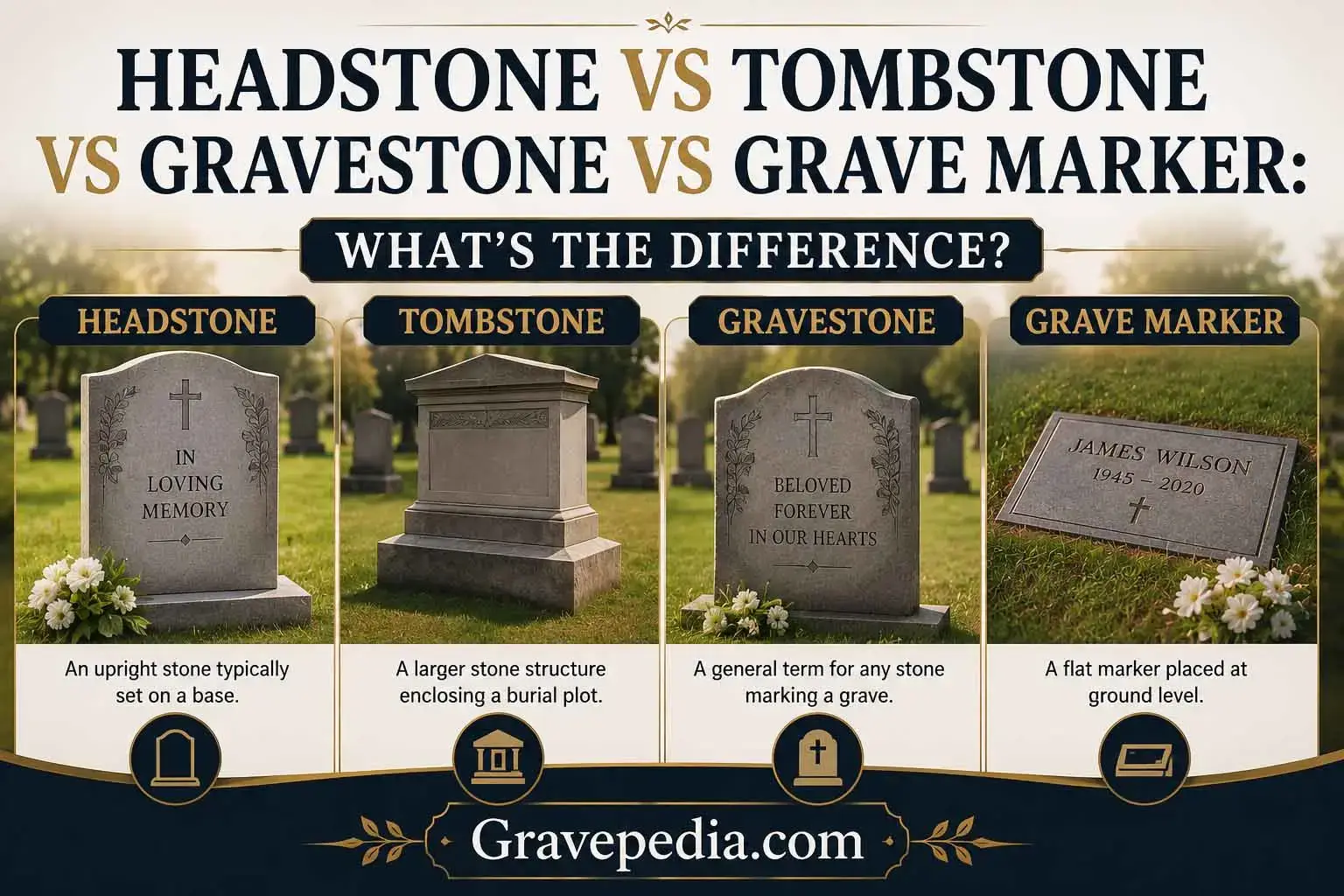
Headstone vs Tombstone vs Gravestone vs Grave Marker: What's the Difference?
Headstone vs Tombstone: Both mean upright stone markers - historically different, now interchangeable
Headstone cost (upright): $1,000 - $3,000 (granite), $5,000 - $10,000+ (marble, custom)
Flat grave marker cost: $200 - $600 (basic), $800 - $2,000 (premium bronze)
Key difference: Upright vs flush with ground - cemetery rules often dictate which is allowed
Headstone vs Tombstone: The Confusion Explained
If you've ever wondered about the difference between headstone and tombstone, you're not alone. People search for "headstone vs tombstone" and "tombstone vs headstone" thousands of times each month because the terms seem interchangeable - and honestly, today they mostly are. But there are historical differences, regional preferences, and specific meanings that matter when you're actually shopping for a grave marker. After visiting dozens of cemeteries across the country and speaking with monument dealers, I've put together this complete guide to help you understand exactly what each term means, which one you need, and how much you should expect to pay. Whether you're planning ahead for yourself or choosing a marker for a loved one, this guide will clear up all the confusion.
What Is a Headstone? Definition & History
A headstone is a stone marker placed at the head of a grave. The word literally means "stone at the head" - head (of the grave) + stone. Historically, headstones were smaller, simpler markers that identified who was buried in that specific plot. They typically stood upright and faced east (toward the sunrise, symbolizing resurrection in Christian tradition). In modern usage, "headstone" is the most common term in the United States for any upright grave marker. When you visit a cemetery, the tall, vertical stones with names and dates carved into them - those are headstones. They're typically made of granite, marble, or bronze. The average headstone costs $1,000-$3,000 for a standard granite marker, with larger, more elaborate headstones reaching $5,000-$10,000 or more.
Modern Headstone Features:
- Upright, vertical orientation
- Placed at the head of the grave (top end)
- Typically 18-36 inches wide, 24-48 inches tall
- Made of granite (most common), marble, bronze, or sandstone
- Includes name, birth date, death date, sometimes epitaph or symbols
- Can include laser-etched photos or custom designs
What Is a Tombstone? Definition & History
A tombstone originally meant a stone that covered a tomb - a stone placed over an entire burial chamber or crypt. The word comes from "tomb" (burial chamber) + "stone." In medieval and ancient cemeteries, wealthy families would place large stone slabs over entire grave plots, often with inscriptions carved into the top surface. Over time, as burials became more individual and cemeteries became more crowded, the "tombstone" shrank and eventually became indistinguishable from headstones. Today, tombstone vs headstone has no real difference - they're the same thing. If you search for "headstone vs tombstone" on Google, you'll find that monument companies use both terms interchangeably. Some people think tombstone is just a more old-fashioned or formal term, while headstone is more modern and casual. But in practice, a tombstone is still the upright stone at the head of a grave.
What Is a Gravestone? The UK vs US Difference
Gravestone is the most common term in the United Kingdom and older American cemeteries. A gravestone is simply a stone that marks a grave - whether upright or flat. The term is a combination of "grave" (burial place) + "stone." In the UK, you'll almost always hear "gravestone" or "headstone" used interchangeably. In the US, "headstone" is more common, but you'll still see "gravestone" used, especially in historical contexts or older cemeteries. So is a gravestone the same as a headstone? Yes, essentially. The difference is mostly regional. If you're from the UK, you probably say gravestone. If you're from the US, you probably say headstone. But both refer to the same thing - a stone marker at a grave.
Regional Usage:
- United States: Headstone (most common), tombstone, gravestone (less common)
- United Kingdom: Gravestone or headstone (both common)
- Australia/Canada: Headstone or memorial stone
- Veterans cemeteries: Often use "government headstone" as official term
What Is a Grave Marker? The Flat Alternative
A grave marker is different from headstones and tombstones. A grave marker is a flat stone that lies flush with the ground, also called a "flat marker," "lawn-level marker," or "grass-level marker." Unlike upright headstones that stand above ground, grave markers are installed at ground level. This makes them easier to maintain (lawn mowers can go right over them) and often less expensive. Flat grave markers typically cost $200-$600 for basic granite, while premium bronze markers can cost $800-$2,000. Many modern cemeteries, especially those in lawn-park style or memorial parks, require flat markers rather than upright headstones because they're easier to maintain and create a more uniform appearance. Some cemeteries have specific sections where upright headstones are allowed and other sections where only flat markers are permitted. Before you buy any marker, always check your cemetery's rules.
Types of Grave Markers:
- Flat Marker: Flush with ground, granite or bronze
- Bevel Marker: Slightly raised (1-3 inches), slanted face
- Slant Marker: Raised in back, slanted toward front (4-8 inches tall)
- Ledger Marker: Covers the entire grave (large, flat stone)
Headstone vs Tombstone vs Gravestone vs Grave Marker: Comparison Table
| Feature | Headstone | Tombstone | Gravestone | Grave Marker (Flat) |
|---|---|---|---|---|
| Orientation | Upright | Upright | Either | Flat/ground level |
| Height | 24-48 inches | 24-48 inches | Varies | 0-3 inches |
| Typical Cost | $1,000-$3,000 | $1,000-$3,000 | $500-$3,000 | $200-$600 |
| Common Material | Granite, marble | Granite, marble | Granite, slate, sandstone | Granite, bronze |
| Maintenance | Mowing required around | Mowing required around | Varies | Low (mower passes over) |
| Cemetery Restrictions | Often restricted | Often restricted | Varies | Usually preferred |
| Primary Usage Region | US (modern) | US (historical/ Western) | UK, older US cemeteries | US, modern lawn cemeteries |
Cost Comparison: Headstone vs Grave Marker
Cost is often the deciding factor when choosing between a headstone and a flat grave marker. Here's what you can expect to pay:
Upright Headstone Costs:
- Basic granite headstone: $1,000 - $1,500
- Mid-range granite headstone (with design): $1,500 - $3,000
- Premium granite or marble headstone: $3,000 - $7,000
- Custom, large, or imported stone: $7,000 - $15,000+
- Installation fee: $200 - $500 (often included in price)
Flat Grave Marker Costs:
- Basic granite flat marker: $200 - $400
- Granite bevel marker (slightly raised): $400 - $700
- Bronze flat marker: $500 - $1,000
- Premium bronze marker with custom design: $1,000 - $2,000
- Installation fee: $150 - $300
Which One Should You Choose? Headstone or Grave Marker?
Choose an Upright Headstone If:
- Cemetery allows upright stones (check first - many modern cemeteries do not)
- You want a traditional, prominent memorial that's easy to see from a distance
- Budget is not a primary concern ($1,000-$3,000+)
- The deceased specifically requested an upright stone
- You want space for detailed carvings, photos, or long epitaphs
Choose a Flat Grave Marker If:
- Your cemetery requires flat markers (most lawn-park cemeteries do)
- You're on a tight budget ($200-$600 vs $1,000-$3,000)
- You prefer a minimalist, uniform cemetery appearance
- You want low maintenance (no concerns about stones tipping or sinking)
- The cemetery charges significantly more for upright stones (sometimes $500-$1,000 extra)
Cemetery Rules for Headstones and Markers
Before you buy any headstone or grave marker, call your cemetery. Every cemetery has its own rules, and violating them can be expensive. Common restrictions include:
- Material restrictions: Some cemeteries only allow granite or bronze (no marble, limestone, or sandstone)
- Size restrictions: Maximum width (24-36 inches), height (18-48 inches), and thickness
- Color restrictions: Some cemeteries only allow certain colors (gray, black, bronze, etc.)
- Flat only sections: Many modern cemeteries have sections where only flat markers are allowed
- Foundation requirements: Some require concrete foundations for upright headstones ($200-$500 extra)
- Installation rules: Some require cemetery staff to install markers (you can't do it yourself)
Pro tip: Ask your cemetery for their "rules and regulations" document before buying anything. It will save you from costly mistakes.
Materials: Granite vs Marble vs Bronze vs Slate
Granite (Most Popular, 90% of headstones)
Granite is the most durable option. It resists weathering, doesn't fade, and comes in many colors (gray, black, pink, blue, green). Cost: $1,000-$5,000. Lasts centuries with minimal maintenance.
Bronze (Popular for flat markers)
Bronze develops a natural patina over time. Very durable but more expensive than granite. Cost: $800-$2,500 (flat markers). Best for: Military and government headstones.
Marble (Traditional, Less Durable)
Marble was common in older cemeteries (pre-1950). It's beautiful but soft - inscriptions fade within 50-100 years. Cost: $2,000-$8,000. Not recommended for modern markers.
Slate (Historical)
Slate was common in colonial America and the UK. It's durable but can flake over time. Cost: $500-$2,000. Mostly used for historical reproductions.
Conclusion: Now You Know the Difference
So what's the final word on headstone vs tombstone? The truth is, for practical purposes, they're the same thing. Both refer to upright stone markers at the head of a grave. Tombstone vs headstone is mostly a matter of personal preference and regional dialect. Gravestone is the common term in the UK, while flat grave markers are different altogether - they lie flush with the ground and cost significantly less. When you're ready to buy, remember these key points: check cemetery rules first, compare prices from at least 3 monument dealers, choose granite for durability, and don't overspend if budget is tight - a flat marker is perfectly respectful and often preferred by modern cemeteries. Whether you choose an upright headstone or a flat grave marker, the most important thing is honoring your loved one's memory in a way that feels right to your family.
Senior Memorial & Cemetery Researcher
Frequently Asked Questions About Headstone vs Tombstone
What is the difference between a headstone and a tombstone?
The difference between headstone and tombstone is mostly historical. Originally, a tombstone covered an entire grave (like a stone slab), while a headstone was placed only at the head. Today, both terms are used interchangeably for upright grave markers. Most people use "headstone" for modern cemeteries and "tombstone" for older graves or Western movies.
Is a gravestone the same as a headstone?
Yes, gravestone vs headstone is essentially the same thing. Gravestone is more common in the UK, while headstone is more common in the US. Both refer to a stone marker at a grave, typically upright and at the head of the burial plot.
What is a flat grave marker called?
A flat grave marker is simply called a grave marker, flat marker, grass-level marker, or lawn-level marker. It lies flush with the ground and is different from an upright headstone. Flat markers cost significantly less ($200-$600) compared to upright headstones ($1,000-$3,000).
Which is cheaper: headstone or flat grave marker?
Headstone vs flat marker cost: Flat grave markers are much cheaper. A basic flat marker costs $200-$600. A basic upright headstone costs $1,000-$3,000. Premium headstones can exceed $10,000. If budget is a concern, choose a flat marker.
Can I have a headstone in any cemetery?
No. Many modern cemeteries, especially "lawn-park" or "memorial park" cemeteries, only allow flat grave markers. Older cemeteries and religious cemeteries (especially Catholic and Jewish) typically allow upright headstones. Always check cemetery rules before purchasing.
What's the best material for a headstone?
Granite is the best material for modern headstones. It's durable, weather-resistant, comes in many colors, and holds inscriptions well for centuries. Marble is softer and inscriptions fade within 50-100 years. Bronze is excellent for flat markers but expensive.
How long does it take to get a headstone after ordering?
Most headstones take 4-12 weeks from order to installation. Simple flat markers may take 2-4 weeks. Custom, carved, or imported stones can take 12-16 weeks. Plan ahead to have the marker ready for the first anniversary of death.
How much does a headstone cost with installation?
A basic granite headstone with installation costs $1,200-$2,000. Premium headstones $3,000-$7,000. Installation alone often costs $200-$500. Some monument companies include installation; others charge separately. Always ask for a complete quote including delivery and installation.
Does a veteran get a free headstone?
Yes, the VA provides a free government headstone or grave marker for any eligible veteran buried in a national cemetery. Options include upright granite headstones or flat bronze markers. Spouses may also be eligible. Contact the VA National Cemetery Administration for details.
Can I put a headstone on a grave years after burial?
Yes, you can add a headstone at any time. Some families wait 6-12 months to allow the grave to settle (prevents leaning stones). Cemetery rules may require you to wait 6 months before installation. There's no time limit - families have added headstones 50+ years after burial.
What's the difference between a headstone and a grave marker?
The main headstone vs grave marker difference is orientation. A headstone is upright (vertical). A grave marker is flat (horizontal, flush with ground). Headstones cost more ($1,000-$3,000) and are more traditional. Grave markers cost less ($200-$600) and are preferred by modern cemeteries.
Contents
- Headstone vs Tombstone: The Confusion
- What Is a Headstone?
- What Is a Tombstone?
- What Is a Gravestone?
- What Is a Grave Marker?
- Comparison Table (4 Types)
- Cost Comparison
- Which One Should You Choose?
- Cemetery Rules
- Material Comparison (Granite, Marble, Bronze)
- Conclusion
- FAQs (11+ Questions)
Evergreen Guide
Based on monument industry standards, cemetery regulations, and consumer price data. Costs and rules vary by location and cemetery.