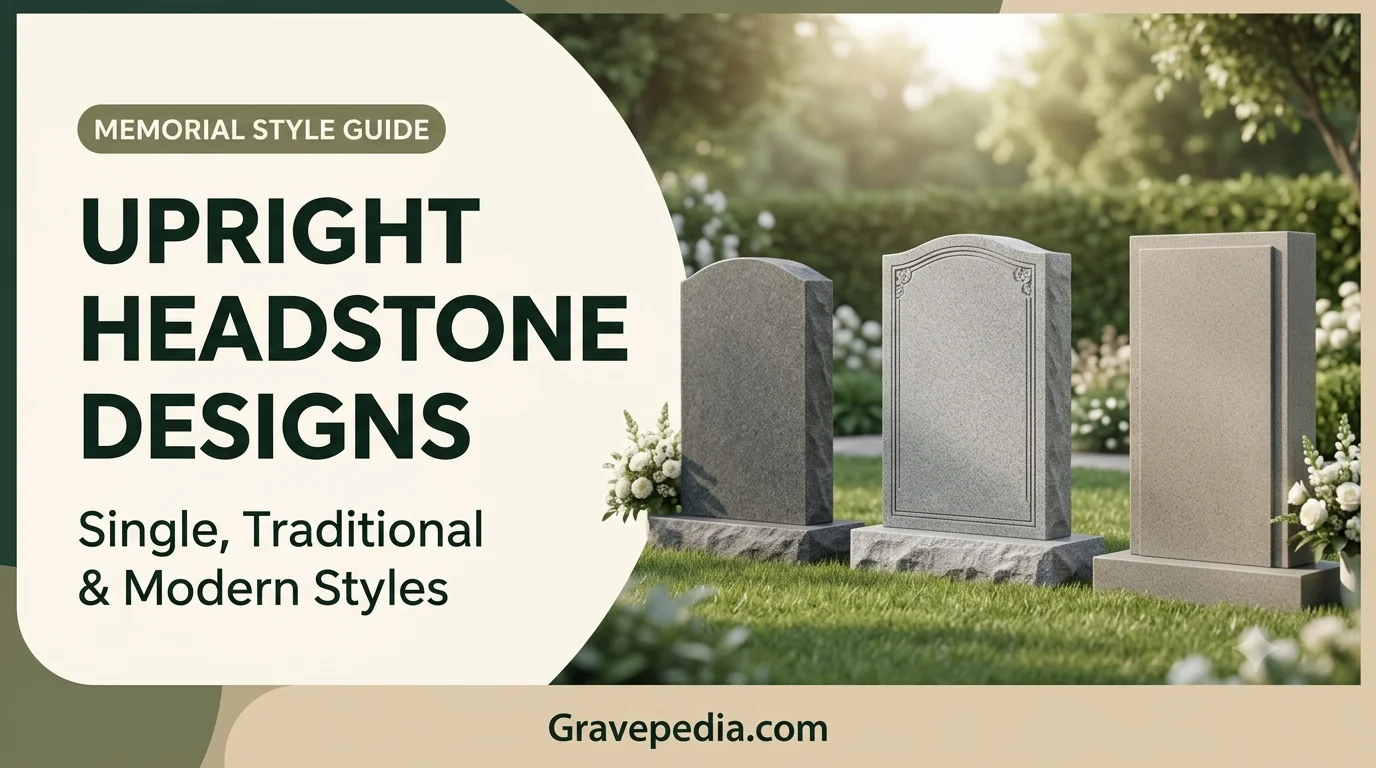
Upright Headstone Designs: Single, Traditional and Modern Styles
Upright headstone designs remain the most traditional and visible way to memorialize a loved one. Standing above the ground, an upright headstone offers a larger canvas for names, dates, inscriptions, and artwork than flat markers. This guide covers what an upright headstone is, popular styles, single headstone shapes and sizes, granite and other material options, engraving ideas, costs and installation, and how upright headstones compare with flat markers.
What Is an Upright Headstone?
An upright headstone, also called a vertical headstone, tablet, or monument, is a memorial that stands above the ground rather than sitting flush with it. It typically consists of a polished face, a base, and sometimes a die or plinth that raises the tablet. This design allows for larger lettering, deeper carving, and more elaborate shapes than flat markers.
Upright headstones have been the standard form of memorialization in Western cemeteries for centuries. They remain the most visible type of grave marker, easily seen from a distance and allowing visitors to identify a grave from the cemetery path. Because they stand vertically, they can display names, dates, epitaphs, and artwork on a larger surface area than flat markers.
The upright design also makes engraving easier to read. Visitors do not have to look down or bend over to see the inscription, which is a practical advantage for older family members and anyone visiting the grave.
Popular Upright Headstone Styles
Upright headstone designs range from simple and traditional to fully custom and modern. The style you choose affects both the appearance and the cost of the memorial.
Traditional styles:
- Round-Top Tablet: A rectangular headstone with a rounded or arched top. This is the most common traditional style, offering a classic appearance and generous space for inscriptions.
- Swan-Neck or Ogee: A tablet with a curved, S-shaped top edge, more decorative than a simple round-top.
- Serpentine Top: A wavy or undulating top edge, often paired with carved floral borders.
- Cross or Cruciform: A headstone shaped like a cross, popular in Christian cemeteries.
- Gothic Arch: A pointed arch top, often used with traditional lettering and religious symbols.
Modern styles:
- Rectangular with Clean Lines: A simple rectangular tablet with sharp edges and minimalist lettering.
- Asymmetric or Organic Shapes: Curved, irregular forms that break from traditional symmetry.
- Book-Shaped: Designed to resemble an open book, with inscriptions on both pages.
- Heart-Shaped: A heart-shaped upright stone, often chosen for spouses or children.
- Boulder or Findling: A natural, unworked stone with a polished face for inscriptions.
- Obelisk or Pillar: Tall, slender upright monuments, often used for family plots.
Single Headstone Shapes and Sizes
A single upright headstone marks one grave. It is the most common type of upright monument, available in many shapes and sizes. Standard dimensions provide a useful reference, but cemeteries often set their own limits.
| Headstone Type | Typical Size | Notes |
|---|---|---|
| Standard Single Upright | 24 x 12 x 4 inch tablet on a 30 x 12 x 6 inch base | Most common size for a single grave |
| Larger Single Upright | 28 x 16 x 6 inch tablet | More space for artwork and inscriptions |
| Small Single Upright | 20 x 10 x 3 inch tablet | Compact option for smaller plots |
| Companion Upright | 48 x 12 x 4 inch tablet | For two people, often spouses |
| Child-Sized Upright | 18 x 10 x 3 inch tablet | Smaller proportions |
Single headstone designs usually include the person's full name, birth and death dates, and an inscription or epitaph. Additional elements such as religious symbols, hobby icons, or laser-etched portraits can be added if space allows. The layout should follow visual hierarchy: the name is the most prominent element, followed by dates and then any inscription.
Granite and Other Material Options
The material you choose affects the appearance, durability, and cost of an upright headstone. Granite is by far the most popular choice for upright monuments, but other materials are also available.
Granite: Granite accounts for roughly 90 percent of headstones sold. It is extremely durable, weather-resistant, and available in a wide range of colors, including gray, black, green, blue, red, and mahogany. Gray granite is typically the least expensive, while black granite costs 10 to 20 percent more due to limited quarry locations. Granite upright headstones can be polished, honed, or sandblasted, and they hold detailed carvings and laser etchings well.
Marble: Marble offers a classic, timeless appearance and is often used for angel statues and traditional monuments. However, marble is softer than granite and more vulnerable to weathering, so it requires more maintenance over time. Marble typically costs 25 to 40 percent more than granite and is less ideal for harsh climates.
Bronze: Bronze markers are usually cast plaques mounted on granite bases. They are durable, weather-resistant, and offer a distinct appearance. Bronze uprights are less common than flat bronze markers but are still used in some cemeteries and for veteran memorials.
Limestone and Sandstone: Softer stones used historically for headstones. They weather faster than granite and are rarely chosen today for new monuments, though they can still be found in older cemeteries.
Upright Headstone Engraving Ideas
Engraving is what makes an upright headstone personal. The vertical face offers plenty of space for names, dates, inscriptions, and artwork.
Lettering and inscriptions:
- Full name: Use the legal name, or a nickname if that is how the person was known.
- Dates: Birth and death dates, and optionally a wedding date or other milestone.
- Epitaph: A short quote, poem, or phrase. Shorter inscriptions age better and cost less per character.
- Font style: Classic Roman lettering, serif, sans-serif, or custom fonts. Lettering should be at least 1 inch tall for the name.
Artwork and symbols:
- Religious symbols: Crosses, Stars of David, lotus flowers, angels, praying hands, or Celtic knots.
- Hobby and career icons: Musical notes, paintbrushes, gardening tools, fishing rods, or symbols of a profession.
- Natural motifs: Roses, lilies, trees, mountains, ocean scenes, or birds.
- Laser-etched portraits: A realistic image of the person etched into granite, often on black granite for maximum contrast.
- Family names or crests: Family surname, coat of arms, or military insignia.
- Personal touches: A signature, a favorite quote, or a meaningful symbol unique to the person.
Some providers include a certain amount of lettering or one artwork element in the base price, with additional images charged separately. Always ask what is included and what costs extra.
Upright Headstone Costs and Installation
Upright headstone costs depend on material, size, design complexity, and engraving. The table below shows typical ranges.
| Headstone Type | Typical Price Range | Notes |
|---|---|---|
| Basic Single Upright Granite | $1,000 to $3,500 | Simple design, standard engraving |
| Mid-Range Single Upright | $2,000 to $4,500 | Larger tablet, more detailed artwork |
| Custom Upright Monument | $4,000 to $6,000+ | Custom shapes, laser etching, detailed carvings |
| Companion Upright Headstone | $3,500 to $8,000 | For two people, larger surface area |
| Installation and Foundation | $150 to $500 | Often charged separately |
Factors that affect cost:
- Material: Granite is generally the most cost-effective. Marble and bronze cost more.
- Color: Rare granite colors such as red, blue, or mahogany cost more than standard gray or black.
- Size: Larger tablets require more material and heavier installation equipment.
- Shape: Custom or sculpted shapes require more labor than standard rectangular tablets.
- Engraving: More lettering, detailed artwork, and laser etching increase the cost.
- Installation: Foundation, delivery, and cemetery fees are often charged separately.
Always request an itemized quote that shows the stone, engraving, installation, foundation, and any cemetery fees separately. This makes it easier to compare quotes from different providers.
Upright Headstones vs. Flat Markers
Upright headstones and flat markers each have advantages and disadvantages. Understanding the differences helps you choose the right memorial for your situation.
| Factor | Upright Headstone | Flat Marker |
|---|---|---|
| Visibility | Highly visible from a distance | Low profile, blends with the ground |
| Engraving Space | Large vertical surface for artwork and text | Limited to the marker surface |
| Typical Cost | $1,000 to $6,000+ | $300 to $1,500+ |
| Maintenance | Requires trimming around the base | Easy to mow over, no trimming |
| Cemetery Rules | Not allowed in all cemeteries | Often required in memorial parks |
| Design Flexibility | High, including custom shapes | Moderate, mostly flat surface |
| Best For | Traditional cemeteries, larger tributes | Memorial parks, budget-conscious families |
Upright headstones are usually preferred when visibility and design space are priorities. Flat markers are preferred when cemetery rules require them, when budget is limited, or when a low-maintenance option is desired.
Upright Headstone Designs: What Families Should Know
When choosing an upright headstone, keep these practical points in mind:
- Confirm the cemetery allows upright headstones before ordering.
- Check size and material restrictions set by the cemetery.
- Granite is the most durable and common material for upright monuments.
- Simple designs often age better than highly detailed or trendy ones.
- Request an itemized quote that separates stone, engraving, installation, and fees.
- Plan the layout so the name is the most prominent element.
- Ask about payment plans if you need to spread the cost.
Taking the time to choose a thoughtful design creates a lasting tribute that honors your loved one for generations.
Frequently Asked Questions About Upright Headstone Designs
What is an upright headstone?
An upright headstone, also called a vertical headstone or tablet, is a memorial that stands vertically above the ground. It typically consists of a polished granite face with a rough or sawn back and base. Upright headstones are the most traditional and visible type of memorial, allowing for larger designs, deeper engraving, and more elaborate shapes than flat markers.
How much does an upright headstone cost?
Upright headstone costs vary widely by material, size, and complexity. A simple single upright granite headstone with basic engraving typically costs $1,000 to $3,500 including installation. Larger or more detailed monuments range from $2,000 to $6,000. Custom-shaped or companion upright headstones can exceed $8,000. Granite color, carving detail, and cemetery fees also affect the final price.
What materials are commonly used for upright headstones?
Granite is the most common material for upright headstones, accounting for roughly 90 percent of the market. It is durable, weather-resistant, and available in many colors, with gray being the least expensive and black granite costing more. Marble offers a classic appearance but is softer and weathers faster. Bronze plaques on granite bases are also used, especially in memorial parks and for veteran markers.
Can you customize a single upright headstone?
Yes. Single upright headstones can be customized in almost every way, including shape, size, granite color, finish, lettering style, inscription, and artwork. Popular customizations include laser-etched portraits, religious symbols, hobby icons, family names, favorite quotes, and unique shapes such as hearts, books, or rounded tops. Cemetery regulations on size and design should be checked before ordering.
Are upright headstones permitted in all cemeteries?
No. Cemetery rules vary widely. Many traditional cemeteries allow upright headstones, while memorial parks and some modern cemeteries require flat or flush markers only for ease of maintenance. Some cemeteries restrict the size, material, and shape of upright monuments. Always check with the cemetery before ordering to ensure the design complies with local regulations.
Final Thoughts
Upright headstone designs offer a classic and visible way to memorialize a loved one. From traditional round-top tablets to modern asymmetric shapes and custom monuments, the vertical format provides generous space for names, dates, inscriptions, and artwork. Granite remains the most durable and cost-effective material for most families. By checking cemetery rules, comparing itemized quotes, and choosing a design that reflects the person's life, you can create a lasting tribute that stands for generations.
Contents
- What Is an Upright Headstone?
- Popular Upright Headstone Styles
- Single Headstone Shapes and Sizes
- Granite and Other Material Options
- Upright Headstone Engraving Ideas
- Upright Headstone Costs and Installation
- Upright Headstones vs. Flat Markers
- What Families Should Know
- FAQs (5 Questions)
- Final Thoughts
Data Update
Based on general upright headstone design information. Actual costs, material availability, and cemetery regulations vary by location and provider. Verify current details with local memorial masons and cemetery authorities before publishing or making arrangements.