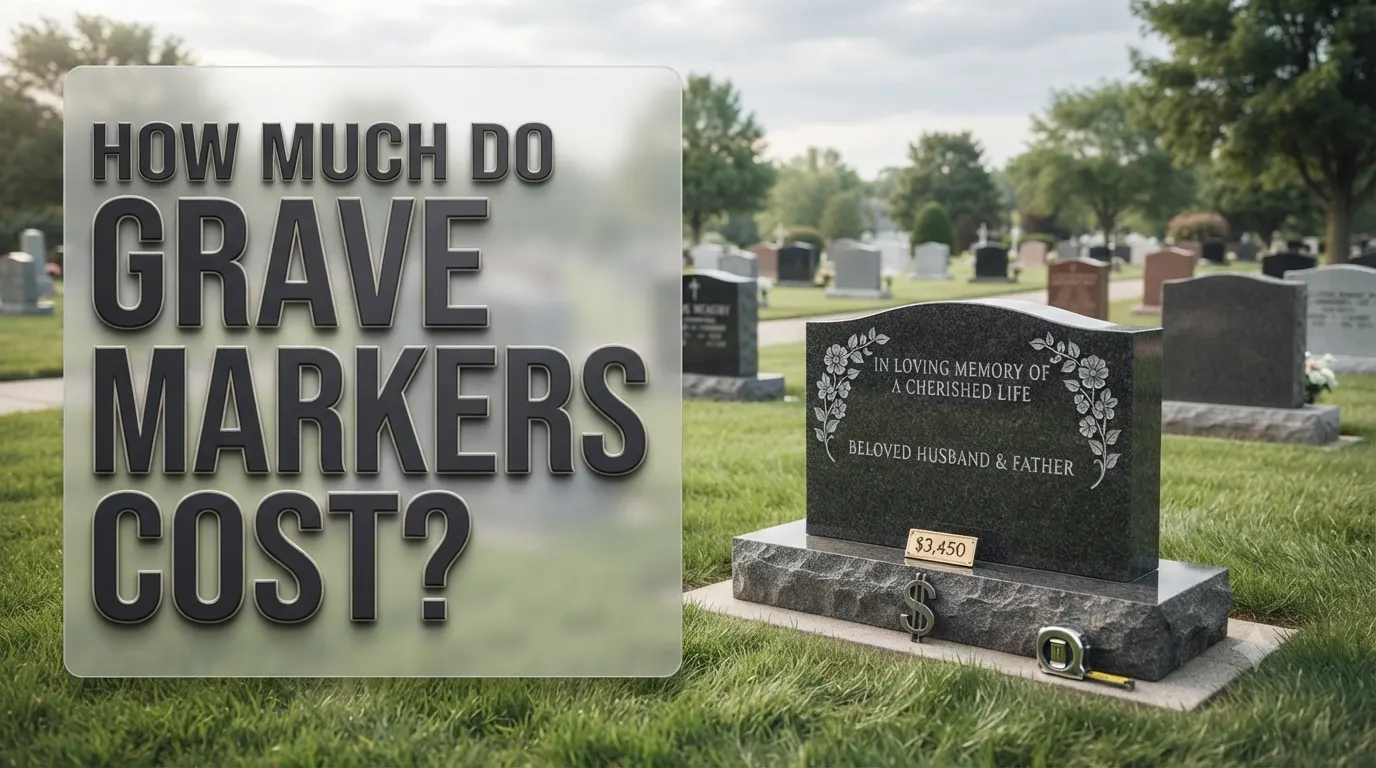
How Much Do Grave Markers Cost
Flat granite markers: $400 - $2,500
Upright headstones: $1,000 - $8,000
Bronze grave markers: $1,500 - $5,000
Companion markers: $2,000 - $12,000
Installation: $200 - $1,000 extra
Cemetery fees: $100 - $500 extra
How Much Do Grave Markers Cost: Full Price Breakdown
When families ask how much do grave markers cost, the honest answer is that it depends on the type, material, size, and where you buy. Grave markers range from about $400 for a simple flat granite marker to more than $15,000 for a large custom upright monument with elaborate engraving and imported stone. Most families spend between $1,000 and $4,000. The marker itself is only part of the cost installation, cemetery fees, and engraving can add hundreds or even thousands of dollars. Understanding the full picture helps you plan ahead and avoid surprises. This page breaks down every cost involved, compares materials, explains what drives prices up or down, and also answers related questions like how do cemeteries make money and how do graveyards make money, so you can see where your money actually goes.
Grave Marker Cost by Type
The biggest factor in how much do grave markers cost is the type of marker you choose. Here is a detailed breakdown of each type.
Flat Grave Markers (Flat Markers)
Flat markers lie flush with the ground and are required in many modern memorial parks. They are the most affordable option.
- Granite flat marker: $400 - $2,500
- Bronze flat marker on granite base: $1,000 - $3,000
- Single flat marker: $400 - $1,500
- Companion flat marker (two names): $800 - $2,500
Upright Headstones (Upright Monuments)
Upright headstones stand above the ground on a base and are traditional in older cemeteries. They cost more because of the extra stone and foundation work.
- Single upright granite headstone: $1,000 - $5,000
- Companion upright headstone: $2,000 - $8,000
- Large custom monument: $5,000 - $15,000+
- Slant marker: $700 - $2,500
Bronze Grave Markers
Bronze markers are cast metal plaques mounted on a granite base. They are durable, elegant, and common in national cemeteries.
- Single bronze marker: $1,500 - $3,500
- Companion bronze marker: $2,500 - $5,000
- Bronze on granite base: $1,000 - $3,000
Other Marker Types
- Concrete marker: $200 - $800 (not allowed in many cemeteries)
- Wooden marker: $100 - $500 (temporary only)
- Metal temporary marker: Free from funeral home, or $50 - $150
- Pet grave marker: $100 - $1,000
Grave Marker Cost by Material
Material choice directly affects how much do grave markers cost. Here is how the most common materials compare.
| Material | Typical Cost | Durability | Notes |
|---|---|---|---|
| Granite | $400 - $8,000 | Excellent | Most popular, wide color range |
| Bronze | $1,000 - $5,000 | Excellent | Cast metal, classic look |
| Marble | $1,000 - $6,000 | Good | Traditional, stains over time |
| Slate | $800 - $4,000 | Good | Historic look, limited colors |
| Sandstone | $500 - $2,000 | Fair | Weathers faster |
| Limestone | $500 - $2,500 | Fair | Soft, erodes over time |
| Concrete | $200 - $800 | Poor | Not allowed in most cemeteries |
Granite is the most popular choice because it is durable, available in many colors, and affordable at every price point. Bronze is favored for its timeless look and is standard in military cemeteries. Marble is traditional but requires more maintenance. When budgeting for how much do grave markers cost, granite usually gives the best value.
Engraving and Design Costs
Engraving adds to the total cost of a grave marker. Basic name, dates, and a short inscription are usually included in the marker price. Custom work costs extra.
- Basic engraving (name, dates): Included in marker price
- Extra lines of text: $5 - $15 per letter
- Custom epitaph: $50 - $300
- Laser-etched portrait: $300 - $1,500
- Ceramic photo: $100 - $500
- Custom artwork or scene: $200 - $2,000
- Family name on back: $100 - $400
- Religious symbols: $50 - $200
If you want a simple marker, engraving costs are minimal. If you want a portrait, custom scene, or long epitaph, expect to add several hundred to over a thousand dollars to your total.
Grave Marker Installation Cost
Installation is a significant part of how much do grave markers cost in total. The marker price you see online often does not include installation.
- Flat marker installation: $200 - $600
- Upright headstone installation: $400 - $1,500
- Large monument installation: $1,000 - $3,000
- Foundation and concrete work: $150 - $800
- Shipping and delivery: $100 - $500
Most cemeteries require installation by a licensed monument company. DIY installation is rarely allowed because of safety and foundation requirements. Always ask whether the quote includes installation before comparing prices.
Cemetery Fees for Grave Markers
Cemeteries charge fees when a marker is placed. These fees are separate from the marker cost and installation.
- Marker placement fee: $100 - $500
- Foundation inspection fee: $50 - $200
- Administrative fee: $25 - $150
- Rush fee: $100 - $300
These fees vary widely by cemetery. Some cemeteries include them in the plot purchase; others charge separately. Always request a written fee schedule before ordering a marker.
How Do Cemeteries Make Money
Understanding how do cemeteries make money helps families see where their payments go and why certain fees exist. Cemeteries earn revenue from several sources, not just plot sales.
1. Burial Plot Sales
The primary revenue source for most cemeteries is selling burial plots. Prices range from $500 in rural areas to over $10,000 in major cities. Prime locations near trees, roads, or family plots cost more.
2. Opening and Closing Fees
Every burial requires digging and refilling the grave. This is called the opening and closing fee, usually $500 to $2,000. It is charged separately from the plot and is a major income source.
3. Grave Marker and Monument Fees
Cemeteries charge for marker placement, foundation work, and inspection. These fees add $100 to $500 per marker and cover administrative costs.
4. Endowment Care Funds
Most cemeteries charge a perpetual care or endowment care fee at the time of plot purchase, usually 10% to 20% of the plot price. This money is invested in a trust fund, and the interest is used for ongoing maintenance.
5. Mausoleum and Columbarium Sales
Above-ground crypts in mausoleums and cremation niches in columbariums sell for $2,000 to $25,000 or more. These are high-margin products with lower maintenance costs.
6. Pre-Need Contracts
Many cemeteries sell pre-need packages that bundle plots, markers, and services at today's prices. These contracts provide upfront cash and reduce risk.
7. Memorial Products
Some cemeteries sell markers, vases, benches, and memorial jewelry directly, earning a markup on each item.
8. Chapel and Event Rentals
Cemeteries with chapels or reception halls rent them for funerals, memorials, and community events, adding another revenue stream.
How Do Cemeteries Make Money After They Are Full
A common question is how do cemeteries make money after they are full. When no more plots can be sold, cemeteries rely on other income streams.
- Endowment care trust interest: The trust fund continues to earn interest, funding maintenance.
- Mausoleum and columbarium additions: New above-ground structures can be built on existing land.
- Cremation services: Cremation niches and scattering gardens generate ongoing revenue.
- Memorial product sales: Markers, vases, and benches continue to sell.
- Re-sale of unused plots: Families sometimes return or resell plots they no longer need.
- Memorial events and tours: Historic cemeteries host tours and events for income.
- Land leasing: Some cemeteries lease unused land for other purposes.
- Donations and grants: Nonprofit cemeteries seek donations and preservation grants.
Even when full, a well-managed cemetery can remain financially stable for decades through these sources. This is how older cemeteries stay maintained long after all plots are sold.
How Do Graveyards Make Money
The terms cemetery and graveyard are often used interchangeably, but graveyards are typically older and smaller, often attached to a church. How do graveyards make money is similar but with some differences.
- Burial fees: Church graveyards charge members and non-members for burial.
- Marker and monument fees: Charges for placement and upkeep.
- Perpetual care funds: Trust funds for maintenance.
- Donations: Church members and descendants donate for upkeep.
- Fundraising events: Tours, concerts, and history events.
- Grants: Historic preservation grants for old graveyards.
Many old graveyards are nonprofit and depend on volunteers and donations. Modern for-profit cemeteries operate more like businesses. Understanding how do graveyards make money helps explain why maintenance varies so much between locations.
Cheapest Grave Markers and How to Save
If budget is a concern, here are ways to reduce how much do grave markers cost:
- Choose a flat granite marker: $400 to $1,500 instead of $3,000+.
- Buy directly from a monument company: Often cheaper than through the funeral home.
- Skip custom engraving: Basic name and dates are usually included.
- Use a single marker for two people: Companion markers cost less per person.
- Check VA benefits: Free markers for eligible veterans.
- Ask about payment plans: Many companies offer 12 to 24 month plans.
- Compare at least three quotes: Prices vary by 30% or more.
VA Grave Markers: Free for Eligible Veterans
The Department of Veterans Affairs provides free grave markers for eligible veterans, which can save families thousands of dollars.
- Flat granite marker: Free
- Upright marble headstone: Free
- Bronze marker: Free
- Installation at national cemetery: Free
- Installation at private cemetery: Partial reimbursement available
Eligibility includes most veterans who served honorably, their spouses, and dependent children. Applying is free and can be done online through the VA website.
Grave Marker Cost Comparison Table
| Marker Type | Marker Cost | Installation | Cemetery Fees | Total |
|---|---|---|---|---|
| Flat granite (single) | $400 - $1,500 | $200 - $600 | $100 - $300 | $700 - $2,400 |
| Flat granite (companion) | $800 - $2,500 | $300 - $800 | $100 - $400 | $1,200 - $3,700 |
| Upright headstone (single) | $1,000 - $5,000 | $400 - $1,200 | $200 - $500 | $1,600 - $6,700 |
| Upright headstone (companion) | $2,000 - $8,000 | $600 - $1,500 | $200 - $500 | $2,800 - $10,000 |
| Bronze marker (single) | $1,500 - $3,500 | $300 - $800 | $100 - $400 | $1,900 - $4,700 |
| Bronze marker (companion) | $2,500 - $5,000 | $400 - $1,000 | $100 - $400 | $3,000 - $6,400 |
| Large custom monument | $5,000 - $15,000+ | $1,000 - $3,000 | $300 - $800 | $6,300 - $18,800+ |
| VA marker (eligible veteran) | $0 | $0 - $500 | $0 - $300 | $0 - $800 |
Factors That Affect How Much Grave Markers Cost
Many factors influence the final price. Knowing them helps you budget accurately.
- Size: Larger markers cost more stone and more to install.
- Material: Granite is cheaper than bronze; imported stone costs more.
- Engraving: Custom portraits and long epitaphs add hundreds.
- Location: City cemeteries charge more than rural ones.
- Cemetery rules: Some require bronze or specific sizes.
- Installation requirements: Foundation specs vary by cemetery.
- Shipping distance: Local stone costs less to deliver.
- Time of year: Winter installations may cost more or be delayed.
- Rush orders: Expedited production adds 20% to 50%.
How to Choose the Right Grave Marker
When deciding on a grave marker, consider these practical points:
- Check cemetery rules first: Some allow only flat markers.
- Set a budget: Include marker, installation, and fees.
- Choose durable material: Granite and bronze last longest.
- Plan the inscription: Keep it simple or add a personal touch.
- Compare three quotes: Prices vary significantly.
- Ask about warranties: Most markers come with a guarantee.
- Confirm timeline: Expect 4 to 12 weeks for installation.
Common Mistakes When Buying a Grave Marker
Avoid these mistakes to keep costs predictable and avoid delays.
- Not checking cemetery rules: Buying a marker that is not allowed.
- Forgetting installation costs: The marker price is not the total.
- Skipping the foundation: Poor foundations cause markers to sink.
- Ordering too soon: Some cemeteries require waiting 6 to 12 months.
- Not comparing quotes: Prices vary by 30% or more.
- Ignoring VA benefits: Eligible veterans get free markers.
- Choosing cheap concrete: Not allowed in most cemeteries.
Conclusion: How Much Do Grave Markers Cost in Total
So, how much do grave markers cost? The short answer is $400 to $15,000, with most families spending $1,500 to $3,000 total. Flat granite markers are the cheapest at $400 to $2,500, upright headstones run $1,000 to $8,000, and bronze markers cost $1,500 to $5,000. Add $200 to $1,000 for installation and $100 to $500 for cemetery fees. If you are eligible for VA benefits, you may pay nothing. Understanding how do cemeteries make money and how do graveyards make money also helps you see where your money goes and why certain fees exist. Whether you choose a simple flat marker or a large custom monument, comparing quotes, checking cemetery rules, and planning ahead will save you money and stress. Start by requesting three quotes from local monument companies and reviewing your cemetery's marker regulations.
Senior Memorial & Cemetery Researcher
Frequently Asked Questions: How Much Do Grave Markers Cost
How much do grave markers cost?
Grave markers cost between $400 and $15,000 depending on type, material, size, and engraving. Flat granite markers cost $400 to $2,500. Upright headstones cost $1,000 to $8,000. Bronze markers cost $1,500 to $5,000. Companion markers cost $2,000 to $12,000. Installation adds $200 to $1,000, and cemetery fees add $100 to $500.
How do cemeteries make money?
How do cemeteries make money they earn from plot sales, opening and closing fees, grave marker installation fees, endowment care funds, mausoleum crypt sales, cremation niche sales, and pre-need contracts. Many cemeteries also earn interest from perpetual care trusts. Some cemeteries operate as nonprofits, while others are for-profit businesses.
How do cemeteries make money after they are full?
How do cemeteries make money after they are full through endowment care trust interest, mausoleum and columbarium additions, cremation services, memorial product sales, grave marker installation, re-sale of unused plots, and hosting memorial events. Some cemeteries also lease land for events or develop unused sections into cremation gardens.
How do graveyards make money?
How do graveyards make money through burial plot sales, interment fees, marker installation charges, perpetual care funds, monument sales, chapel rentals, and pre-arranged funeral plans. Older graveyards often rely on trust fund interest and donations, while modern cemeteries run as full businesses.
What is the cheapest grave marker?
The cheapest grave markers are flat granite markers starting around $400 to $800. Simple bronze markers on granite bases start around $1,000. Concrete markers cost as little as $200 but are not allowed in many cemeteries. Temporary markers are usually free from the funeral home.
Does the VA pay for grave markers?
Yes, the VA provides free headstones and markers for eligible veterans, including flat granite markers, upright marble headstones, and bronze markers. The VA also pays for installation at national cemeteries. For private cemeteries, the VA may reimburse part of the installation cost.
How long does it take to get a grave marker installed?
Grave marker installation usually takes 4 to 12 weeks after ordering. This includes design approval, engraving, shipping, and cemetery approval. Some cemeteries have waiting periods before a marker can be placed, often 6 to 12 months after burial to allow the ground to settle.
Can I install a grave marker myself?
Most cemeteries require installation by a licensed monument company. DIY installation is rarely allowed because of safety, foundation, and leveling requirements. Some small family cemeteries may permit self-installation, but you must check the cemetery rules first.
What is the average cost of a headstone?
The average headstone cost is $1,000 to $3,000 for a single upright granite marker, or $2,000 to $6,000 for a companion headstone. Including installation and cemetery fees, most families spend $1,500 to $4,000 total.
Are flat grave markers cheaper than upright headstones?
Yes, flat grave markers are generally cheaper. A flat granite marker costs $400 to $2,500, while an upright headstone costs $1,000 to $8,000. Flat markers also cost less to install because they require less foundation work.
Do grave markers come with engraving included?
Basic engraving of the name and dates is usually included in the marker price. Extra lines of text, custom epitaphs, laser-etched portraits, and artwork cost additional fees ranging from $50 to $1,500.
How much does a bronze grave marker cost?
A bronze grave marker costs $1,500 to $3,500 for a single marker and $2,500 to $5,000 for a companion marker. Bronze markers on granite bases cost $1,000 to $3,000. Bronze is durable and commonly used in national cemeteries.
Can I buy a grave marker online?
Yes, you can buy grave markers online from monument companies, but you must confirm the cemetery will accept an outside marker. Many cemeteries require installation by a licensed company. Always compare online prices with local quotes before ordering.
How much does it cost to add a name to an existing headstone?
Adding a name to an existing headstone costs $100 to $400, depending on the stone type and lettering style. Matching the existing engraving style may cost more. Some monument companies charge a minimum fee for small engraving jobs.
Contents
- Full Price Breakdown
- Cost by Type
- Cost by Material
- Engraving and Design
- Installation Cost
- Cemetery Fees
- How Do Cemeteries Make Money
- How Do Cemeteries Make Money After Full
- How Do Graveyards Make Money
- Cheapest Grave Markers
- VA Grave Markers
- Cost Comparison Table
- Factors Affecting Cost
- How to Choose
- Common Mistakes
- Conclusion
- FAQs (14+ Questions)
Data Update
Based on monument company price surveys, cemetery fee schedules, and VA benefit guidelines. Prices vary by location and provider.