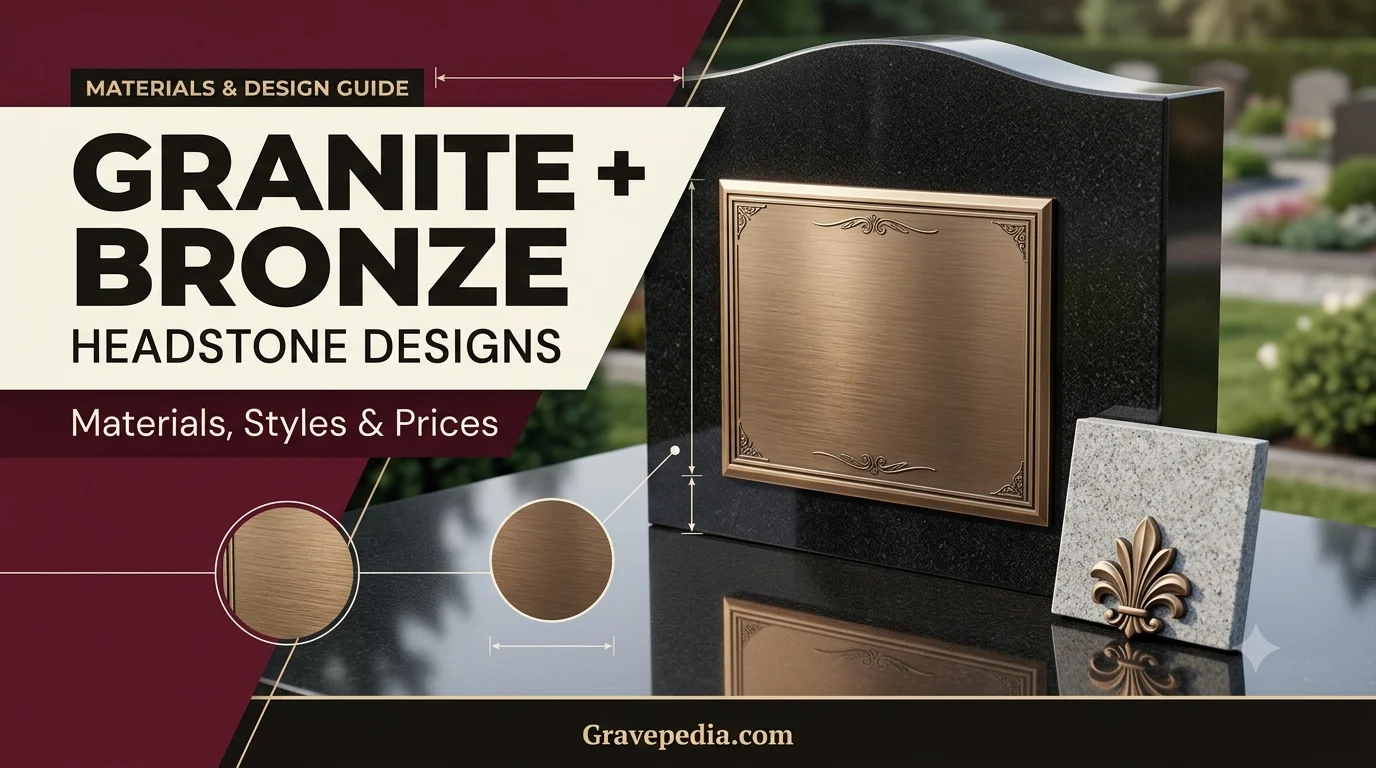
Granite and Bronze Headstone Designs: Materials, Styles and Prices
Granite headstone designs and bronze grave marker designs are the two most popular choices for memorials in the United States. Granite offers durability, a wide range of colors, and excellent support for detailed engraving and laser etching. Bronze markers, cast in solid metal and usually mounted on granite bases, offer a traditional appearance and lasting legibility. This guide covers common headstone materials, granite designs and finishes, black granite monuments, bronze marker styles, durability and maintenance comparisons, material costs, and how to choose the right material for a memorial.
Common Headstone Materials
Several materials are used for headstones, each with different durability, appearance, and cost characteristics. Understanding the options helps families make an informed choice.
Granite: The most popular material for headstones in the United States. Granite is an igneous rock formed from solidified molten material, making it extremely hard and dense. It is weather-resistant, available in many colors, and holds detailed engraving and laser etching well. Granite accounts for roughly 90 percent of headstones sold and is the material of choice for upright monuments, flat markers, companion headstones, and memorial benches.
Bronze: A cast metal alloy, typically composed of copper and other metals. Bronze grave markers are cast plaques that are usually mounted on granite or concrete bases. The lettering, dates, emblems, and borders are raised and polished, while the background is finished in a dark color for contrast. Bronze is valued for its traditional appearance, durability, and lasting legibility.
Marble: A metamorphic rock that offers a classic, luxurious appearance. Marble is softer than granite and more vulnerable to weathering, so it requires more maintenance. It is often used for angel statues and traditional monuments, but is less common for new headstones in harsh climates.
Limestone and Sandstone: Softer stones used historically for headstones. They weather faster than granite and are rarely chosen today for new monuments, though they can still be found in older cemeteries.
Slate: A metamorphic rock that allows very fine lettering and is among the longest-lasting materials in churchyards. Slate is less common in the United States but remains a traditional choice in parts of the United Kingdom.
Granite Headstone Designs and Finishes
Granite's versatility makes it suitable for a wide range of headstone designs and finishes. The material can be shaped, carved, and finished in many ways to create a memorial that reflects the person being honored.
Surface finishes:
- Polished: A glossy, reflective surface that shows engraving clearly. Polished granite is the most common finish for headstones.
- Honed or Matte: A softer, non-reflective finish that reduces glare. Honed granite creates an understated, elegant appearance.
- Sandblasted: A textured finish often used for lettering and designs.
- Rock Pitch or Natural Edge: A rough, unpolished edge that contrasts with polished faces, often used on boulder-style memorials.
- Steeled or Chiseled: A textured finish that adds depth and character to the stone.
Engraving and personalization options:
- Sandblasted Engraving: The traditional method for cutting letters, numbers, and designs into granite. A rubber stencil protects the polished areas while abrasive material carves the exposed stone. The carved channels are often filled with paint for contrast.
- Laser Etching: Uses computer-controlled lasers to burn extremely fine details into polished granite. This method is ideal for reproducing photographs, detailed illustrations, and delicate designs. Black granite is preferred for laser etching because its dark background provides maximum contrast.
- Hand Etching: A specialized art form where a skilled craftsperson carves a portrait or scene directly into the granite surface. Hand etching produces results with an artistic quality that laser etching cannot fully replicate.
- Gold Leaf and Metallic Fills: Gold leaf lettering on black granite creates an elegant, classic appearance. Silver and bronze paint fills offer similar contrast at a lower cost.
Common granite headstone styles:
- Upright Tablet: The traditional vertical headstone, available in rectangular, round-top, or custom shapes.
- Flat Marker: Set flush with the ground, economical and widely accepted by cemeteries.
- Slant and Bevel Markers: Angled markers that are easier to read than flat markers.
- Companion Headstone: Designed for two people, often spouses, with space for both names and dates.
- Kerb Sets with Surrounds: A headstone with a border of stone forming a rectangular edge covering the grave plot.
Black Granite Headstones and Monuments
Black granite is a particularly popular choice for headstones because of its striking appearance and exceptional suitability for laser etching. It is one of the most widely used granites in the US memorial market.
Why black granite is preferred for laser etching: Laser etching works by removing microscopic points from the polished granite surface. Where the laser strikes, the exposed stone beneath the polish appears lighter, creating contrast against the remaining black polished areas. Black granite is essential for this process because it provides the maximum contrast between the polished surface and the exposed stone. Lighter granites lack the contrast needed for detailed imagery.
What can be laser-etched on black granite: Nearly any high-resolution image can be laser-etched onto a black granite headstone, including portrait photographs, wedding photos, family group portraits, scenic landscapes, military service photos, pets, and hobby-related imagery.
Durability of laser etching: Because the laser physically removes material from the granite surface rather than applying ink or paint, the etching is permanent. The image will remain as long as the surrounding polish holds, which on quality black granite can be 50 to 100 years in most climates. Unlike ceramic photos or paint-filled engravings, laser etchings do not peel, crack, or fade from UV exposure.
Black granite monument prices: A simple single upright black granite marker with basic engraving typically ranges from $1,500 to $4,000. Companion or double black granite headstones range from $3,000 to $7,000 or more. Laser-etched portraits and custom artwork add several hundred dollars. Installation and cemetery fees are usually charged separately.
Bronze Grave Markers: Styles and Features
Bronze grave markers are cast plaques that identify a burial place. They are either set flush with the lawn on a granite or concrete base, or mounted to an upright headstone or slant marker.
Key features of bronze markers:
- Raised Lettering: The lettering, dates, emblems, and border are all raised and polished, while the background is finished in a dark brown or black color so the inscription stands out clearly.
- Cast as One Solid Piece: Because the marker is cast as one solid piece, it holds up to mowers, weather, and time far better than engraved stone or aluminum.
- Cemetery Acceptance: Cast bronze is one of the most widely accepted materials for grave markers in the United States, and many lawn cemeteries require flush bronze markers on a granite base.
Common bronze marker sizes:
- Single Grave: 12 x 8 inches and 16 x 10 inches are the most common sizes.
- Companion Markers: 24 x 12 inches or larger for two people.
- Custom Sizes: Available to match specific cemetery requirements.
Design options for bronze markers:
- Lettering: Classic serif, script, and modern typefaces. Every line is raised polished bronze.
- Emblems and Motifs: Flowers, doves, crosses, military and fraternal emblems, or a photo for a ceramic or integrated bronze picture.
- Borders: Single line, double line, decorative, and corner styles.
- Finish: Dark brown, black, or antique background with a clear protective coat.
Design your own bronze grave marker: Many bronze marker providers offer online design tools that allow families to choose the size, border, lettering, and motifs, see the price instantly, and approve a free proof before the marker is cast.
Granite vs. Bronze: Durability and Maintenance
Both granite and bronze are durable materials that last for generations, but they age differently and require different levels of care.
| Factor | Granite | Bronze |
|---|---|---|
| Durability | Extremely durable, essentially permanent when properly finished | Very durable, resists mowers, weather, and time |
| Maintenance | Very low, occasional cleaning with water and mild detergent | Low, washing with mild detergent and occasional waxing |
| Aging | Does not rust, corrode, or discolor | Develops a natural patina over 70 to 80 years |
| Weather Resistance | Excellent, resists all climates | Excellent, but can be affected by bronze disease in some climates |
| Theft Risk | Low, granite has little scrap value | Higher in some markets due to scrap metal value |
Cleaning granite: Granite headstones need very little maintenance. Regular cleaning with clean water and a soft cloth or natural bristle brush is usually sufficient. For tougher stains, a mild non-ionic detergent can be used. Avoid power washers, bleach, and acidic cleaners, which can damage the stone or painted lettering.
Cleaning bronze: Bronze markers can be washed with detergent and warm water. To delay the natural patina, a thin film of car or floor polish can be applied with a soft brush and buffed back. Avoid leaving artificial flowers or other objects on the plaque, as they can cause staining.
Material Costs and Price Comparisons
Granite and bronze have different cost structures. Granite is generally more affordable for comparable sizes, while bronze markers are typically more expensive due to the casting process and the cost of the metal.
| Material | Typical Price Range | Notes |
|---|---|---|
| Granite (single upright, basic) | $1,500 to $4,000 | Includes basic engraving; installation extra |
| Granite (companion upright) | $3,000 to $7,000+ | For two people; depends on size and detail |
| Black Granite (premium) | $4,000 to $12,000+ | Laser etching, portraits, custom shapes |
| Bronze Marker (12 x 8 inch) | $800 to $1,500 | Includes casting; granite base extra |
| Bronze Plaque (larger) | $1,500 to $5,000+ | Depends on size, emblems, and borders |
| Granite Base for Bronze | $200 to $800 | Required for flush mounting |
Granite pricing factors: Domestic versus imported origin, color rarity and demand, cubic or square footage needed, and surface finish all affect granite cost. Typical granite ranges from $20 to $100 or more per cubic foot.
Bronze pricing factors: The foundry process involves significant manual labor, including die-casting, finishing, and quality control. Bronze markers typically cost $1,500 to $5,000 for plaques, depending on size and complexity, plus granite base costs.
Choosing the Right Material for a Memorial
Choosing between granite and bronze depends on several factors, including cemetery rules, budget, design preferences, and maintenance considerations.
- Check Cemetery Rules First: Some cemeteries require flat bronze markers in certain sections, while others allow granite uprights. Confirm the allowed materials, sizes, and styles before making a decision.
- Consider the Design You Want: If you want a laser-etched portrait or detailed artwork, black granite is the best choice. If you prefer traditional raised lettering and emblems, bronze may be more suitable.
- Evaluate Your Budget: Granite is generally more affordable for comparable sizes. Bronze markers cost more upfront, especially when the granite base is included.
- Think About Maintenance: Both materials require minimal care. Granite needs occasional cleaning with water. Bronze may develop a patina over time, which some families prefer and others choose to delay with waxing.
- Consider Long-Term Durability: Both materials last for generations. Granite is essentially permanent and does not corrode. Bronze is also highly durable but may tarnish over time.
- Review the Overall Appearance: Granite offers a wide range of colors and finishes. Bronze provides a traditional, warm appearance with raised lettering that stands out clearly.
Granite and Bronze Headstone Designs: What Families Should Know
When choosing between granite and bronze for a headstone, keep these practical points in mind:
- Granite is the most popular and widely accepted material for headstones in the US.
- Black granite is the best choice for laser-etched portraits and detailed artwork.
- Bronze markers are cast plaques, usually mounted on granite bases, with raised lettering.
- Granite is generally more affordable than bronze for comparable sizes.
- Both materials are durable and last for generations.
- Granite requires very little maintenance; bronze may develop a patina over time.
- Check cemetery rules on allowed materials and sizes before ordering.
- Request a proof and approve it before production begins.
Frequently Asked Questions About Granite and Bronze Headstone Designs
Is granite a good material for a headstone?
Yes. Granite is the most popular material for headstones because it is extremely durable, weather-resistant, and available in a wide range of colors. It holds detailed engraving and laser etching well, and requires very little maintenance. Granite headstones can remain legible for a century or more with occasional cleaning.
How much do black granite headstones cost?
Black granite headstone costs vary by size, design, and engraving. A simple single upright black granite marker with basic engraving typically ranges from $1,500 to $4,000. Companion or double black granite headstones range from $3,000 to $7,000 or more. Laser-etched portraits and custom artwork add several hundred dollars. Installation and cemetery fees are usually charged separately.
Are bronze grave markers more expensive than granite?
Yes, bronze grave markers are generally more expensive than comparable granite markers. A standard 12 x 8 inch cast bronze marker typically costs around $800 to $1,500, while larger bronze plaques with emblems and borders can range from $1,500 to $5,000 or more. Bronze markers are usually mounted on granite bases, which adds to the total cost.
Which headstone material lasts the longest?
Granite and bronze are both extremely durable. Granite is essentially permanent when properly finished, and it does not rust, corrode, or discolor. Bronze also lasts for generations, though it develops a natural patina over time. In terms of sheer longevity with minimal maintenance, granite is often considered the most durable option for headstones.
How do you maintain a granite headstone?
Granite headstones need very little maintenance. Regular cleaning with clean water and a soft cloth or natural bristle brush is usually sufficient. For tougher stains, a mild non-ionic detergent can be used. Avoid power washers, bleach, and acidic cleaners, which can damage the stone or painted lettering. Bronze markers can be washed with mild detergent and occasionally waxed to delay patina.
Final Thoughts
Granite and bronze are the two most popular materials for headstones in the United States, each offering distinct advantages. Granite provides exceptional durability, a wide range of colors, and the best surface for laser-etched portraits and detailed artwork. Bronze offers a traditional appearance with raised lettering and lasting legibility. Both materials require minimal maintenance and last for generations. By checking cemetery rules, considering your design goals and budget, and choosing a material that fits your needs, you can create a memorial that honors your loved one for years to come.
Contents
- Common Headstone Materials
- Granite Headstone Designs and Finishes
- Black Granite Headstones and Monuments
- Bronze Grave Markers: Styles and Features
- Granite vs. Bronze: Durability and Maintenance
- Material Costs and Price Comparisons
- Choosing the Right Material for a Memorial
- What Families Should Know
- FAQs (5 Questions)
- Final Thoughts
Data Update
Based on general granite and bronze headstone information. Actual costs, material availability, and cemetery regulations vary by location and provider. Verify current details with local memorial masons and cemetery authorities before publishing or making arrangements.