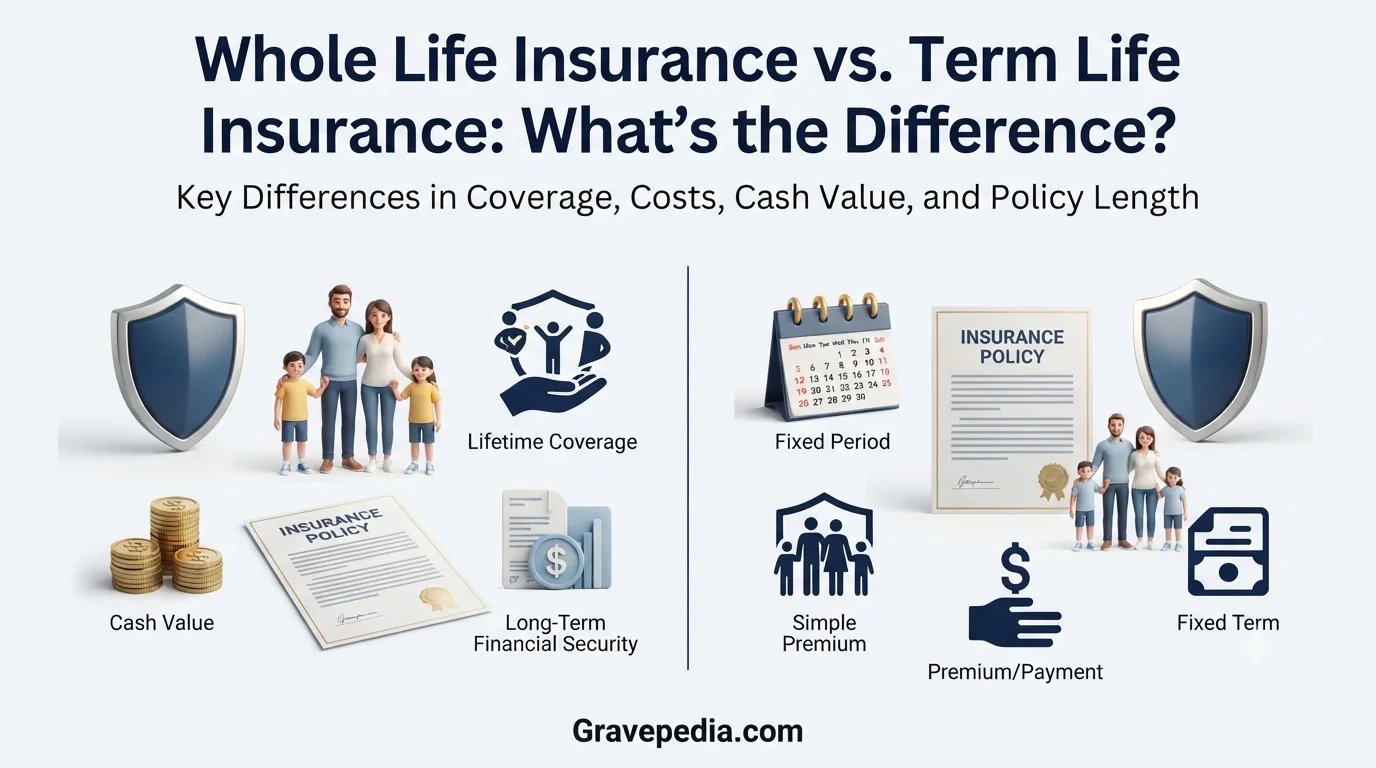
Whole Life Insurance vs Term Life Insurance: What's the Difference?
Whole life insurance: $300 - $500/month (for $500K)
Term life insurance: $17 - $47/month (for $100K-$1M)
Cash value: Whole life only (+900% tax-deferred)
Coverage range: $100K - $1M+ (both types)
Risk level: Low for both types
Best for: Term for temporary needs, Whole for lifetime
Whole Life vs Term Life Insurance: Full Comparison Guide
When families ask about whole life insurance vs term life insurance, the honest answer is that these two products serve fundamentally different purposes. Term life insurance provides coverage for a set period, typically 10 to 30 years, with no cash value. Whole life insurance provides coverage for your entire lifetime and includes a cash value component that grows tax-deferred. In the United States, term life costs between $17 and $47 per month for $100,000 to $1,000,000 in coverage, while whole life costs between $300 and $500 per month for $500,000 in coverage.
Most families spend between $20 and $100 per month on term life insurance and between $300 and $500 per month on whole life insurance. The policy itself is only part of the cost — riders, conversion options, and payment schedules can add hundreds or even thousands of dollars over the life of the policy. Understanding the full picture helps you plan ahead and avoid surprises.
This page breaks down everything about whole life vs term life insurance, explains the key differences, compares costs in the United States, explains what drives prices up or down, and also answers related questions like whole life cash value, term life coverage, and which policy is right for you.
What Is Term Life Insurance
Term life insurance is pure protection. You choose a coverage amount and a term length — typically 10, 20, or 30 years. If you die during that period, your beneficiaries receive the death benefit, tax-free. If you outlive the term, the policy simply expires with no payout and no refund.
The defining characteristic of term life is its simplicity. There's no investment component, no cash value accumulation, and no complex riders unless you add them. You're essentially renting coverage for a set period. This is why term life is so affordable — you are paying only for the death benefit, not for a savings component [citation:5].
Term life insurance is also called a term life policy. It is the most affordable type of life insurance available. Unlike whole life insurance, term life has no cash value component.
How Much Does Term Life Cost in the U.S.
Term life is remarkably affordable — far cheaper than most Americans assume. According to LIMRA research, over half of consumers estimate term life costs three times higher than it actually does. A healthy 30-year-old male can get a $250,000, 20-year term policy for around $185 per year — less than $16 monthly [citation:5].
For $500,000 coverage, here are approximate monthly rates for healthy nonsmokers [citation:17]:
- 10-Year Term: $17/month for a 30-year-old man
- 20-Year Term: $24 to $30/month for a 30-year-old
- 30-Year Term: $37/month for a 30-year-old man
What Is Whole Life Insurance
Whole life insurance — also called permanent life insurance — provides coverage for your entire lifetime as long as you pay premiums. Unlike term, it never expires. Your beneficiaries will receive the death benefit whenever you die, whether that's in 5 years or 50.
But whole life offers something else: a cash value component. Part of every premium payment goes toward building a savings pool that grows tax-deferred at a guaranteed rate. You can borrow against this cash value, withdraw from it, or surrender the policy for its accumulated value [citation:13].
Whole life insurance is also called full life insurance or life insurance whole life. The terms are used interchangeably. The policy combines a guaranteed death benefit with a savings component.
How Much Does Whole Life Cost in the U.S.
Whole life costs substantially more than term — typically 5 to 10 times more for the same coverage amount. For $500,000 of whole life coverage, average monthly rates for healthy nonsmokers are [citation:11]:
- Age 30: Women ~$408/month | Men ~$472/month
- Age 40: Women ~$303/month | Men ~$337/month (for $500K)
For a smaller $100,000 whole life policy, a 25-year-old female nonsmoker might pay around $860 annually — roughly $72 monthly [citation:11].
The cost differential exists because whole life guarantees a payout eventually. With term, the insurer only pays if you die during the term — and statistically, many policyholders outlive their coverage.
Key Differences: Whole Life vs Term Life
Understanding the difference between whole life insurance and term life insurance helps you choose the right policy for your needs.
| Feature | Term Life Insurance | Whole Life Insurance |
|---|---|---|
| Coverage Duration | 10, 20, or 30 years | Lifetime |
| Cash Value | No | Yes, grows tax-deferred |
| Premium Stability | Fixed for term | Fixed for life |
| Cost | Most affordable | 5-10x more than term |
| Death Benefit | Guaranteed if die during term | Guaranteed |
| Borrowing | No borrowing | Can borrow against cash value |
| Best For | Maximum coverage on budget | Lifetime coverage, estate planning |
Whole Life vs Term Life Cost Comparison
The biggest factor in whole life vs term life insurance cost is the type of policy you choose. Here is a detailed breakdown of costs in the United States.
| Coverage Amount | Term Life (Monthly) | Whole Life (Monthly) | Difference |
|---|---|---|---|
| $100,000 | $17 | $72 | Term costs less |
| $250,000 | $25 | $180 | Term costs less |
| $500,000 | $30 | $472 | Term costs less |
| $750,000 | $38 | $650 | Term costs less |
| $1,000,000 | $47 | $850 | Term costs less |
Term life insurance costs significantly less than whole life for the same coverage. This is because term life provides pure protection with no savings component. Whole life costs more because it builds cash value and provides lifetime coverage.
Whole Life vs Term Life Cost by Age
Age is one of the biggest factors in whole life vs term life insurance cost. Here is how rates compare for different ages in the United States.
| Age | Term Life (20-Year, $500K) | Whole Life ($500K) | Difference |
|---|---|---|---|
| 25 years | $18 | $320 | Term costs less |
| 30 years | $24 | $472 | Term costs less |
| 35 years | $32 | $580 | Term costs less |
| 40 years | $45 | $700 | Term costs less |
| 45 years | $65 | $850 | Term costs less |
| 50 years | $95 | $1,050 | Term costs less |
| 55 years | $145 | $1,300 | Term costs less |
| 60 years | $220 | $1,600 | Term costs less |
Term life rates increase dramatically with age because the risk of death rises. Whole life rates also increase with age but less steeply because the cash value component offsets some of the cost. Buying life insurance at a younger age locks in lower rates for both types.
Whole Life Cash Value: How It Works
The cash value component is what makes whole life insurance fundamentally different from term life insurance. Here is how it functions in the United States market:
Tax-Deferred Growth
Your cash value grows without being taxed annually, similar to a retirement account. You only owe taxes if you surrender the policy and the cash value exceeds your total premiums paid [citation:4].
Guaranteed Growth Rate
Unlike investments tied to market performance, whole life cash value grows at a rate guaranteed by the insurance company. It will not decline during market downturns. Typical guaranteed growth rates are 2 to 4 percent annually [citation:4].
Access Options
You can borrow against your cash value at competitive interest rates. The loan does not need to be repaid during your lifetime, but unpaid loans reduce the death benefit your beneficiaries receive. You can also withdraw cash value directly, though this reduces the death benefit [citation:13].
Dividends (Participating Policies)
Many whole life policies from mutual insurers are "participating," meaning they may pay dividends when the company performs well. These dividends can be taken as cash, used to reduce premiums, or reinvested to purchase additional coverage [citation:4].
Term Life Insurance Benefits
Term life insurance offers several benefits that make it the best choice for most families. Here are the main advantages.
1. Affordable Premiums
Term life insurance is the most affordable type of life insurance. A healthy 30-year-old can get $500,000 in coverage for around $25 to $30 per month. This makes it accessible to almost everyone [citation:5].
2. Maximum Coverage for Your Budget
Because term life is so affordable, you can buy more coverage for the same premium. This means better protection for your family at a lower cost.
3. Fixed Premiums
Term life premiums are fixed for the length of the term. You will pay the same amount every month or year, regardless of changes in your health. This makes budgeting predictable.
4. Tax-Free Death Benefit
The death benefit is typically tax-free for beneficiaries in the United States. Your family receives the full payout without owing taxes.
5. Simple Application Process
Term life insurance is easier to apply for than whole life. Many policies require only a health questionnaire and no medical exam. Approval can be same-day.
6. Conversion Options
Many term life policies can be converted to permanent coverage without a medical exam. This gives you flexibility if your needs change [citation:3].
Whole Life Insurance Benefits
Whole life insurance offers several benefits that make it attractive for certain financial situations. Here are the main advantages.
1. Lifetime Coverage
Whole life insurance never expires as long as you pay premiums. Unlike term life, which ends after a set period, whole life provides coverage for your entire lifetime. This guarantees a death benefit for your beneficiaries whenever you die.
2. Tax-Deferred Cash Value Growth
The cash value component grows tax-deferred, meaning you do not pay taxes on gains until you withdraw or surrender the policy. This can be a valuable tax advantage for high-income earners [citation:4].
3. Guaranteed Premiums
Whole life premiums are fixed and never increase. You will pay the same amount every month or year, regardless of changes in your health or age. This makes budgeting predictable.
4. Guaranteed Death Benefit
Your beneficiaries are guaranteed to receive the death benefit as long as premiums are paid. The payout is typically tax-free in the United States.
5. Borrowing Power
You can borrow against your cash value at competitive interest rates. This provides liquidity without needing to qualify for a loan or credit check [citation:13].
6. Potential Dividends
Participating whole life policies may pay dividends, which can be taken as cash, used to reduce premiums, or reinvested for additional coverage [citation:4].
Who Should Choose Term Life Insurance
Term life insurance is right for most families. Here is who benefits most from this type of policy.
- Young families on a budget: Term life provides maximum coverage at the lowest cost.
- People with temporary needs: Mortgage protection, income replacement during working years.
- Income earners: Those whose families depend on their income.
- People with debt: Those who want to ensure debts are paid off if they die.
- Investors: Those who prefer to invest the premium difference in higher-return vehicles.
Who Should Choose Whole Life Insurance
Whole life insurance is not right for everyone. Here is who benefits most from this type of policy.
- People who want lifetime coverage: Whole life never expires, so you are covered for your entire life.
- High-income earners: Those who have maxed out retirement accounts and want another tax-advantaged savings vehicle.
- Estate planning: Those who need liquidity to pay estate taxes or leave a legacy.
- Business owners: Whole life can be used for buy-sell agreements and key person insurance.
- People who value forced savings: Whole life builds cash value automatically, providing disciplined savings.
Factors That Affect Whole Life vs Term Life Insurance Cost
Many factors influence the final price. Knowing them helps you budget accurately.
- Age: Younger applicants pay less for both term and whole life insurance.
- Health: Pre-existing conditions, smoking, and BMI affect rates significantly.
- Gender: Women typically pay less than men for the same coverage.
- Coverage amount: Higher coverage costs more but reduces per-dollar cost.
- Term length: Longer terms cost more for term life insurance.
- Policy type: Whole life costs 5 to 10 times more than term life.
- Insurer: Rates vary by 30 percent or more between companies.
- Riders: Additional benefits like waiver of premium add cost.
- Payment frequency: Annual payments cost less than monthly.
- Occupation: Hazardous jobs increase premiums.
How to Choose the Right Life Insurance Policy
When deciding between whole life insurance and term life insurance, consider these practical points:
- Choose term life if: You need maximum coverage on a limited budget, your need is temporary, or you prefer to invest the difference.
- Choose whole life if: You want coverage that never expires, you are using it for estate planning, or you value forced savings.
- Check your budget: Include premiums, riders, and any conversion options.
- Compare at least three quotes: Prices vary by 30 percent or more.
- Consider your health: No-exam policies are faster but may cost more.
- Think long-term: Term life expires; whole life is permanent.
- Review beneficiaries: Keep your beneficiary designations up to date.
Common Mistakes When Buying Life Insurance
Avoid these mistakes to keep costs predictable and avoid delays.
- Buying too little coverage: 10 to 15 times your income is recommended.
- Choosing the first quote: Prices vary significantly between insurers.
- Ignoring health class: Improving health can lower your premiums.
- Not considering conversion options: Term policies with conversion riders offer flexibility.
- Forgetting about riders: Waiver of premium and accelerated death benefits add value.
- Overlooking cash value: Understand how cash value grows and how to access it.
- Not reviewing policies annually: Life changes may require coverage adjustments.
Conclusion: Whole Life vs Term Life Insurance in Total
So, whole life vs term life insurance? The short answer is that term life insurance costs $17 to $47 per month for $100,000 to $1,000,000 in coverage, while whole life insurance costs $300 to $500 per month for $500,000 in coverage. Term life is the most affordable option for most families, providing maximum coverage at the lowest cost. Whole life is more expensive but provides lifetime coverage and builds cash value that grows tax-deferred.
Understanding whole life insurance benefits, term life insurance coverage, and whole life cash value also helps you see where your money goes and why certain premiums exist. Whether you choose a simple term life policy or a comprehensive whole life insurance plan, comparing quotes, checking your health status, and planning ahead will save you money and stress. Start by requesting three quotes from local insurance agents and reviewing your coverage needs.
Frequently Asked Questions: Whole Life vs Term Life Insurance
What is the difference between whole life and term life insurance?
Whole life insurance provides lifetime coverage with a cash value component that grows tax-deferred. Term life insurance provides coverage for a set period, typically 10 to 30 years, with no cash value. Whole life costs 5 to 10 times more than term life but builds savings over time. Term life is cheaper but expires.
How much does whole life insurance cost compared to term life?
Whole life insurance costs between $300 and $500 per month for $500,000 in coverage in the United States. Term life insurance costs between $17 and $47 per month for $100,000 to $1,000,000 in coverage. A healthy 30-year-old male pays around $472 per month for whole life and $24 to $30 per month for term life with the same coverage.
Does whole life insurance build cash value?
Yes, whole life insurance builds cash value that grows tax-deferred at a guaranteed rate. You can borrow against this cash value or withdraw from it. The cash value grows over time and is not taxed annually. Term life insurance has no cash value.
Which is better whole life or term life insurance?
Term life is better for most families because it provides maximum coverage at the lowest cost. Whole life is better for those who want lifetime coverage, estate planning, or a forced savings vehicle. Many financial advisors recommend buying term life and investing the difference.
Can I convert term life to whole life insurance?
Yes, many term life policies include a conversion option that allows you to convert to whole life insurance without a new medical exam. Conversion must usually happen before a certain age or before the term ends. Premiums will increase significantly after conversion.
What happens if I outlive my term life policy?
If you outlive your term life policy, coverage ends and no death benefit is paid. You may be able to renew the policy at a higher premium or convert to permanent coverage. Many term policies offer guaranteed renewability, but rates increase with age.
How long does whole life insurance last?
Whole life insurance lasts your entire lifetime as long as you continue to pay premiums. Unlike term life insurance, which expires after a set period, whole life insurance never expires. The policy remains in force until death or until you surrender it.
Is whole life insurance a good investment?
Whole life insurance is not primarily an investment, but it does build cash value at a guaranteed rate. Returns are typically 2 to 4 percent annually, which is lower than stock market averages. However, whole life offers guaranteed growth, tax advantages, and lifetime protection.
What is the average cost of whole life insurance in the United States?
The average whole life insurance cost in the United States is $472 per month for a healthy 30-year-old male with $500,000 in coverage. Rates range from $300 to $500 per month for $500,000 in coverage. Women typically pay less than men, and younger applicants pay less than older ones.
What is the average cost of term life insurance in the United States?
The average term life insurance cost in the United States is $26 per month for a 20-year, $500,000 policy for a healthy 30-year-old. Rates range from $17 to $47 per month for $100,000 to $1,000,000. Women typically pay less than men, and younger applicants pay less than older ones.
Can I borrow against my whole life insurance?
Yes, you can borrow against the cash value of your whole life insurance policy. Loans are typically charged at competitive interest rates. The loan does not need to be repaid during your lifetime, but unpaid loans reduce the death benefit your beneficiaries receive.
What are the benefits of term life insurance?
The main benefits of term life insurance include affordable premiums, maximum coverage for your budget, fixed premiums for the term, tax-free death benefit for beneficiaries, simple application process, and the ability to convert to permanent coverage. Term life is ideal for temporary needs.
What are the benefits of whole life insurance?
The main benefits of whole life insurance include lifetime coverage that never expires, tax-deferred cash value growth, guaranteed premiums that never increase, a guaranteed death benefit for beneficiaries, the ability to borrow against cash value, and potential dividends from participating policies.
Who should buy term life insurance?
Term life insurance is best for young families on a budget, people with temporary needs like mortgage protection, income earners whose families depend on their income, people with debt, and investors who prefer to invest the premium difference in higher-return vehicles.
Contents
- Full Comparison Guide
- What Is Term Life
- What Is Whole Life
- Key Differences
- Cost Comparison
- Cost by Age
- Cash Value Explained
- Term Life Benefits
- Whole Life Benefits
- Who Should Choose Term
- Who Should Choose Whole
- Factors Affecting Cost
- How to Choose
- Common Mistakes
- Conclusion
- FAQs (14+ Questions)
Data Update
Based on insurance company rate surveys, Policygenius data, and NAIC data. Prices vary by location and provider.