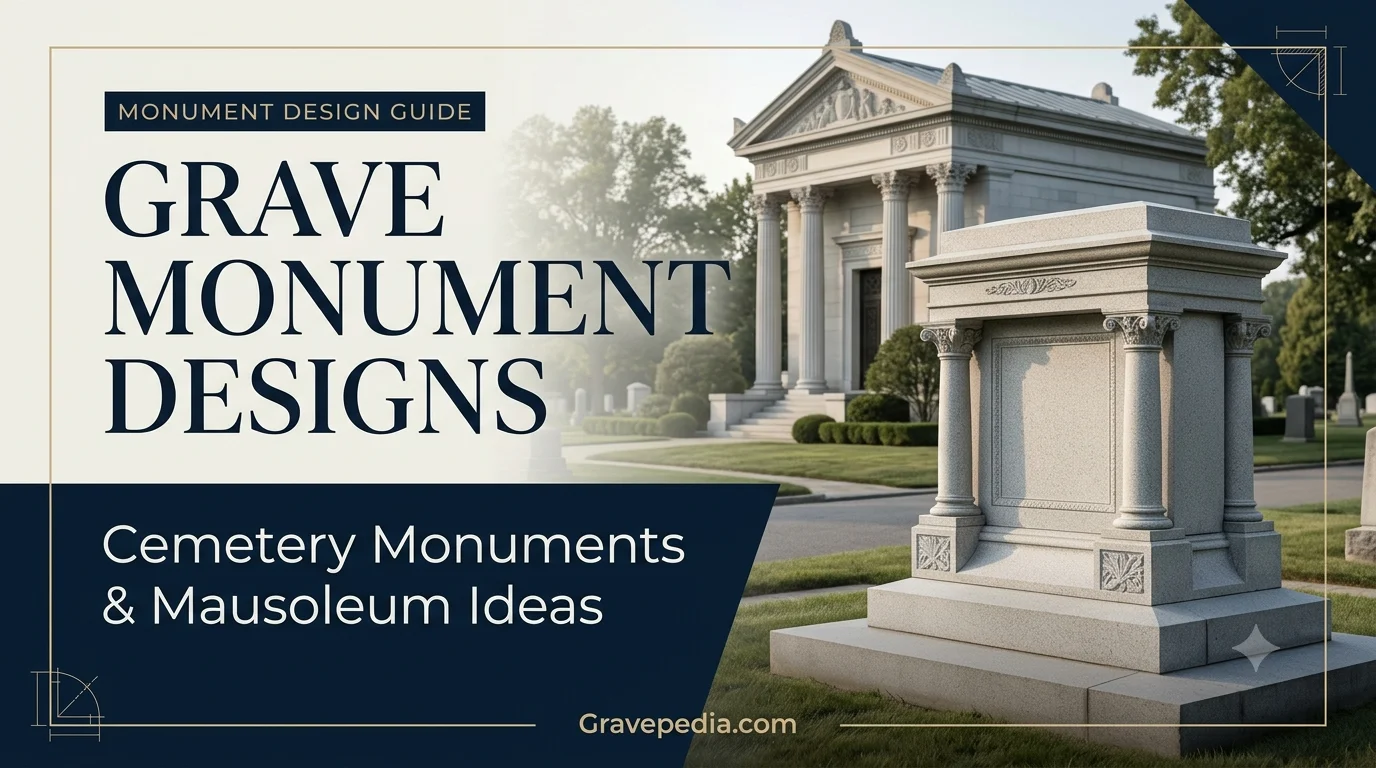
Grave Monument Designs: Cemetery Monuments and Mausoleum Ideas
Grave monument designs offer a lasting way to honor a loved one through substantial, enduring memorials. From traditional upright monuments and companion stones to private family mausoleums, cemetery monuments create a permanent tribute that stands for generations. This guide covers what a cemetery monument is, types of grave monument designs, mausoleum and family mausoleum ideas, choosing monument shapes and materials, custom monument design and engraving, costs, installation and maintenance, and cemetery regulations for large memorials.
What Is a Cemetery Monument?
A cemetery monument is a memorial structure placed at a grave or family plot to honor and identify the deceased. The term monument is broader than headstone. While a headstone specifically refers to an upright slab set at the head of a grave, a monument can refer to any substantial memorial structure, including large family lot stones, obelisks, mausoleums, and other commemorative structures.
In practice, the terms headstone and monument are often used interchangeably for upright markers. However, within the cemetery industry, there is a distinction. A monument may refer to a large family lot stone that does not identify any specific grave, while a marker identifies a specific grave with a name and dates. A headstone is a marker placed at the head of a specific burial.
Cemetery monuments are typically made from granite, marble, or bronze, with granite being the most popular choice due to its durability and weather resistance. They can range from simple upright tablets to elaborate custom structures that serve as family estate memorials.
Types of Grave Monument Designs
Grave monument designs range from traditional upright markers to large-scale family memorials. The type you choose depends on cemetery rules, family preference, and budget.
Common monument types:
- Upright Tablet Monument: The traditional vertical headstone, available in rectangular, round-top, or custom shapes. Single upright monuments typically range from 16 x 20 inches to 24 x 30 inches, with prices from $1,500 to $2,300 for single graves.
- Companion Upright Monument: Designed for two people, often spouses. Sizes range from 36 x 22 inches to 60 x 28 inches, with prices from $2,700 to $5,000.
- Slant and Bevel Monuments: Angled markers that are easier to read than flat markers and often required in some cemetery sections.
- Flat Markers: Set flush with the ground, economical and widely accepted by memorial parks.
- Ledger Stones: Full-length stones covering the grave, also called grave covers.
- Obelisks: Tall, slender four-sided monuments, often used for family plots or military memorials.
- Exedra or Bench Memorials: A curved or straight bench with a back wall, often used in family estates. Modern adaptations use a simple garden bench against a tablet or screen.
- Family Estate Memorials: A unified area with in-ground burial spaces, cremation memorials, benches, coping, ledgers, walkways, or landscaping. Family estates may be 20 x 20 feet or larger and can include a central upright stone up to six feet tall.
Monument shapes: Common shapes include rectangular, round-top, serpentine, Gothic arch, cross, heart, book, and obelisk. Custom shapes are also available, subject to cemetery approval.
Mausoleum and Family Mausoleum Designs
A mausoleum is an above-ground structure built to entomb the deceased. Mausoleums offer an alternative to traditional in-ground burial and can be designed for individuals, families, or communities.
Types of mausoleums:
- Community Mausoleum: Also called a public indoor or garden mausoleum. Space for individuals and families in a shared structure with multiple levels or wings. Average cost is $4,000 to $8,000 for a single crypt.
- Garden Mausoleum: Blends indoor and outdoor elements, often set in tranquil, landscaped surroundings. Includes crypts and niches for cremated remains, with costs of $7,000 to $15,000 for a single crypt.
- Private Family Mausoleum: A custom-built structure designated for one family. Can house multiple crypts or niches, often with decorative features and inscriptions honoring multiple family members. Prices range from approximately $94,000 for a two-crypt granite structure to nearly $2 million for a large private estate, with the middle of the range near $160,000.
Family mausoleum design features: Private mausoleums can include architectural carvings, stained glass, statues, interior benches or small chapels for reflection, bronze doors, and decorative granite finishes. Some are designed to house both caskets and cremated remains, allowing generations of family members to share a single structure.
Additional costs for mausoleums: Beyond the structure price, families should budget for the cemetery plot and site fee, foundation and site work, engraving for the family name and individual inscriptions, opening and closing fees, cemetery approval fees, and ongoing maintenance or restoration costs.
Choosing Monument Shapes and Materials
The shape and material of a monument affect both its appearance and its durability. Granite is the most common material, but other options exist.
Monument materials:
- Granite: The most popular material for monuments due to its durability, weather resistance, and wide range of colors. Granite is an igneous rock that is extremely hard and dense. It holds detailed engraving and laser etching well and requires very little maintenance.
- Marble: Offers a classic, luxurious appearance. Marble is softer than granite and more vulnerable to weathering. It is often used for angel statues and traditional monuments.
- Bronze: Cast metal plaques and elements are used for monuments, often mounted on granite bases. Bronze offers raised lettering and emblems that stand out clearly.
- Limestone and Sandstone: Softer stones used historically. They weather faster than granite and are rarely chosen today for new monuments.
Monument finishes:
- Polished: Glossy, reflective surface that shows engraving clearly.
- Honed or Matte: Softer, non-reflective finish that reduces glare.
- Sandblasted: Textured finish often used for lettering and designs.
- Rock Pitch or Natural Edge: Rough, unpolished edge that contrasts with polished faces.
- Steeled or Chiseled: Textured finish that adds depth and character.
Choosing a shape: The shape should complement the cemetery setting and provide sufficient space for inscriptions and artwork. Common shapes include rectangular, round-top, serpentine, and custom forms like hearts, books, and obelisks. Cemetery regulations may restrict certain shapes or sizes.
Custom Monument Design and Engraving
Custom monument design allows families to create a memorial that genuinely reflects the person being honored. The process involves selecting a design, working with a monument builder, and approving a proof before production.
Customization options:
- Sculptures: Three-dimensional carvings depicting religious figures, angels, or personalized designs. Can be intricate carvings on the headstone or standalone statues.
- Engravings: Sandblasting for deep, precise lettering and simple designs. Laser etching for detailed images, including portraits and complex scenes.
- Photographs: Ceramic photo plaques or laser-etched images on black granite.
- Symbols and Icons: Crosses, Stars of David, military insignias, musical instruments, sports equipment, or other symbols of personal significance.
- Custom Shapes: Heart-shaped, book-shaped, obelisk, or natural boulder designs.
The design process:
- Choose the Monument Type: Decide between upright monuments, pillow markers, flat markers, or larger structures.
- Select Materials: Choose granite color and finish. Granite is the most popular for its durability and low maintenance.
- Design the Tribute: Choose wording, inscriptions, fonts, layout, symbols, artwork, and photographs.
- Review and Approve: Receive a design proof showing the full layout. Check spelling of names, dates, inscriptions, layout, spacing, and artwork carefully. Once approved and signed, the design moves to production.
- Engraving and Craftsmanship: The monument is engraved using the chosen technique. Most monuments are completed within several weeks to a few months.
- Delivery and Installation: The monument is delivered and installed according to cemetery requirements.
Monument Costs, Installation and Maintenance
Monument costs vary widely based on size, material, design complexity, and cemetery fees. The table below shows typical price ranges.
| Monument Type | Typical Price Range | Notes |
|---|---|---|
| Single Upright Monument | $1,500 to $2,300 | 16 x 20 to 24 x 30 inches |
| Companion Upright Monument | $2,700 to $5,000 | 36 x 22 to 60 x 28 inches |
| Large Custom Monument | $10,000 to $50,000+ | Obelisks, family estate stones |
| Community Mausoleum Crypt | $4,000 to $8,000 | Single crypt in shared structure |
| Garden Mausoleum Crypt | $7,000 to $15,000 | Single crypt, landscaped setting |
| Private Family Mausoleum | $94,000 to $1,995,000 | Middle of range near $160,000 |
| Installation and Foundation | $200 to $1,000+ | Often charged separately |
Additional costs to plan for:
- Cemetery Fees: Many cemeteries charge setting fees, care and maintenance fund contributions, and inspection fees. For example, an upright monument up to 4 feet may require a $200 care and maintenance contribution, while monuments at least 4 feet require $400.
- Installation: Professional installation with foundation is often included in monument pricing, but some cemeteries charge separately.
- Engraving: Additional inscriptions beyond the included text are charged per character or by design complexity. Hand tooled family name on the back may cost $275 or more.
- Vases and Accessories: Granite vases may cost $250 or more, and additional base length may be required.
- Porcelain Photos: Recessed porcelain photo plaques typically cost $395 and up.
Maintenance: Granite monuments require very little maintenance. Regular cleaning with clean water and a soft cloth is usually sufficient. Avoid power washers, bleach, and acidic cleaners. Bronze elements can be washed with mild detergent and occasionally waxed to delay patina. Mausoleums may require occasional cleaning, inspection, sealing, and bronze care.
Cemetery Regulations for Large Memorials
Cemetery regulations for large memorials are strict and vary widely. Families must obtain approval before ordering or installing any monument, and larger structures often require additional documentation.
Common cemetery regulations:
- Size Limits: Many cemeteries set maximum height, width, and thickness for monuments. One example limits monuments to 30 inches in height and 12 inches in thickness, with monuments placed within a 42-inch wide concrete foundation strip and a 6-inch border retained around all monuments. Another allows upright monuments up to 72 inches in height on a 20-inch wide foundation pad, with larger monuments requiring cemetery board approval.
- Material Restrictions: Monuments must generally be made of granite, marble, limestone, bronze, or other approved resilient materials. Plastic, fiberglass, and wood monuments are typically not permitted, except for pre-approved wooden crosses.
- Approval Process: Families must submit a detailed sketch or drawing showing the monument's material, height, size of base, and inscription to the cemetery operator for approval before ordering or installation.
- Foundation Requirements: Monuments must be placed on concrete, marble, or granite bases. Foundation pads may require minimum thickness and reinforcement. One cemetery requires granite pads to be a minimum of 4 inches thick and concrete pads to be a minimum of 6 inches thick and reinforced, with 6-inch diameter by 12-inch deep piers at each corner.
- Section-Specific Rules: Different sections of a cemetery may have different rules. Cremation areas may require flat markers only, rising no more than 6 inches above grade. Babyland may require upright granite markers of specific dimensions. Family estates may allow one central upright stone up to 6 feet tall, with all other markers flush with the ground.
- Installation Timing: New memorials may only be installed after a specified period following burial. One cemetery requires 12 months after a full burial and 3 months after an ashes burial before a new memorial can be installed.
- Maintenance Responsibility: The purchaser may be responsible for ongoing maintenance. Cemeteries reserve the right to require repair or removal of any monument deemed in disrepair.
Grave Monument Designs: What Families Should Know
When designing a cemetery monument, keep these practical points in mind:
- A monument is a broader term than headstone and can include large family stones, mausoleums, and obelisks.
- Single upright monuments cost $1,500 to $2,300; companion monuments cost $2,700 to $5,000.
- Private family mausoleums range from $94,000 to nearly $2 million.
- Granite is the most durable and popular material for monuments.
- Customization options include sculptures, engravings, photographs, and symbols.
- Cemetery regulations on size, material, and placement are strict and must be checked first.
- Large monuments and mausoleums require cemetery approval and engineering documentation.
- Request a proof and approve it carefully before production begins.
Frequently Asked Questions About Grave Monument Designs
What is the difference between a headstone and a monument?
A headstone is an upright slab set at the head of a grave, usually bearing the person's name, dates, and an inscription. A monument is a broader term that can refer to any memorial structure, including larger family lot stones, mausoleums, obelisks, and other substantial memorials that may not identify a specific grave. In practice, the terms are often used interchangeably for upright headstones.
How much does a cemetery monument cost?
Cemetery monument costs vary widely by size, material, and complexity. Single upright granite monuments typically range from $1,500 to $4,000. Companion monuments for two people range from $2,700 to $5,000. Larger custom monuments, obelisks, and family estate memorials can cost $10,000 to $50,000 or more. Private family mausoleums range from approximately $94,000 to nearly $2 million, with the middle of the range near $160,000.
What is a family mausoleum?
A family mausoleum is a private, above-ground structure built to entomb multiple family members. It can hold caskets, cremation urns, or both, and is often designed to serve several generations. Private family mausoleums range from simple two-crypt granite structures to large estates with interior chapels, stained glass, and decorative carvings. Community mausoleum crypts, by contrast, are spaces within a shared building and typically cost $4,000 to $15,000.
Can you customize a grave monument?
Yes. Grave monuments can be customized in nearly every way, including shape, size, material, color, finish, lettering, inscriptions, artwork, and symbols. Customization options include sandblasted engraving, laser etching, hand carving, sculptures, ceramic photographs, and laser-etched portraits. Custom shapes such as hearts, books, and obelisks are also available. Cemetery regulations should be checked before finalizing any custom design.
What permissions are needed for a large cemetery monument?
Large cemetery monuments typically require approval from the cemetery operator before ordering or installation. Families may need to submit a detailed sketch or drawing showing the monument's dimensions, material, design, and inscription. Many cemeteries set maximum height, width, and thickness limits, and some restrict the type of monument allowed in certain sections. Private mausoleums require additional approval, engineering documentation, and foundation specifications.
Final Thoughts
Grave monument designs offer a lasting and substantial way to honor a loved one. From single upright monuments and companion stones to private family mausoleums, cemetery monuments create a permanent tribute that stands for generations. Granite remains the most durable and popular material, and customization options allow families to create a memorial that truly reflects the person being remembered. By checking cemetery regulations, understanding costs, and working with a reputable monument builder, you can create a monument that brings comfort and meaning for years to come.
Contents
- What Is a Cemetery Monument?
- Types of Grave Monument Designs
- Mausoleum and Family Mausoleum Designs
- Choosing Monument Shapes and Materials
- Custom Monument Design and Engraving
- Monument Costs, Installation and Maintenance
- Cemetery Regulations for Large Memorials
- What Families Should Know
- FAQs (5 Questions)
- Final Thoughts
Data Update
Based on general grave monument information. Actual costs, material availability, and cemetery regulations vary by location and provider. Verify current details with local monument builders and cemetery authorities before publishing or making arrangements.