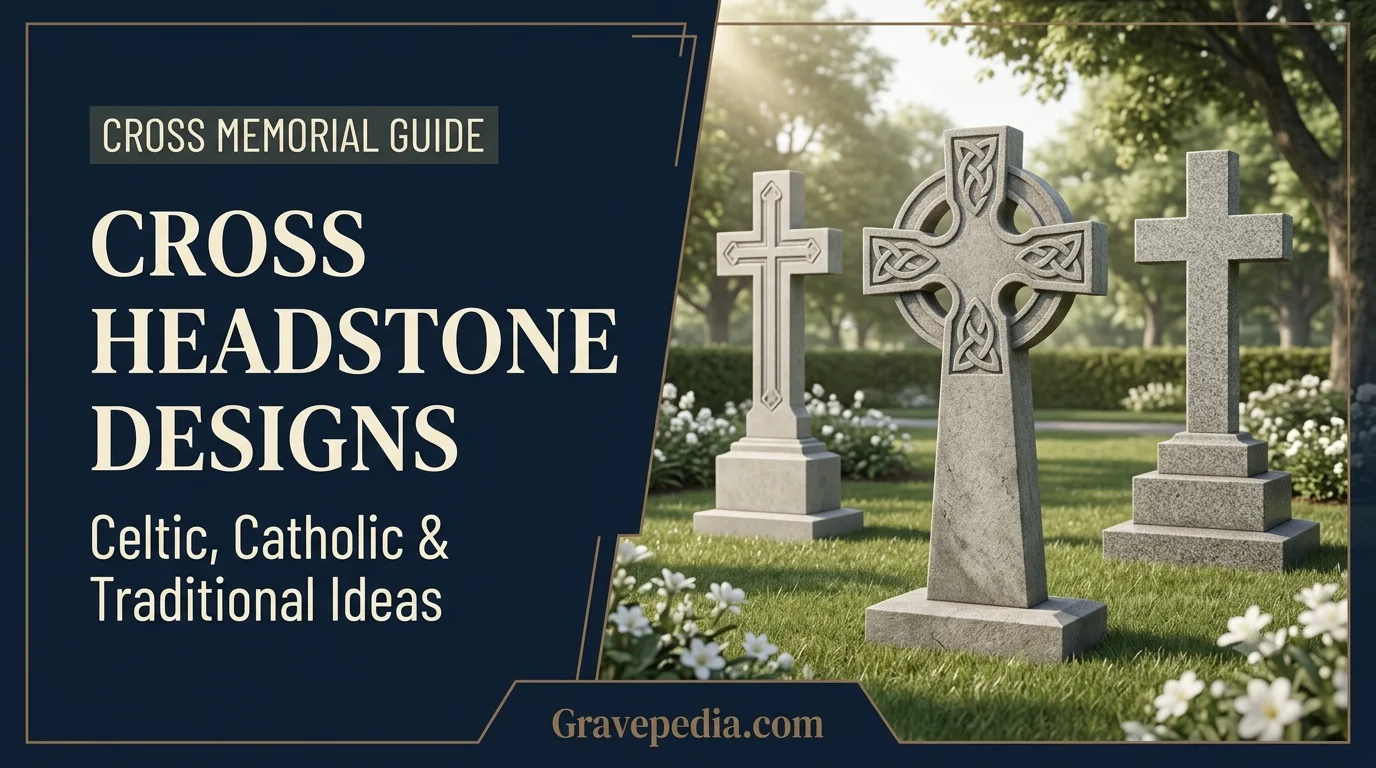
Cross Headstone Designs: Celtic, Catholic and Traditional Ideas
A cross design for headstone is one of the most enduring and meaningful ways to honor a loved one's faith. From the simple Latin cross to the ornate Celtic cross, religious symbols on headstones carry deep meaning and offer comfort to families. This guide covers popular religious headstone designs, Christian cross ideas, Celtic cross styles and prices, Catholic headstone options, Jewish headstone traditions and symbols, materials and engraving, and the costs and cemetery rules to consider.
Popular Religious Headstone Designs
Religious symbols have been used on headstones for centuries to express faith, hope, and the promise of eternal life. For Christians, the cross is the central symbol of the faith, representing the sacrifice of Jesus and the hope of resurrection. For Jewish families, the Star of David and traditional Hebrew inscriptions serve a similar purpose of identification and remembrance.
The most common religious symbols found on headstones include:
- The Cross: The most recognized Christian symbol, representing faith and salvation. Many variations exist, including the Latin cross, Celtic cross, Greek cross, and crucifix.
- Angels: Guardians and messengers between God and the living. Angels blowing trumpets represent the day of judgment, while flying angels symbolize rebirth.
- Dove: Represents the Holy Spirit, purity, and peace. In Christian symbolism, the dove often carries an olive branch.
- Praying Hands: A symbol of devotion and asking God for eternal life.
- Alpha and Omega: The first and last letters of the Greek alphabet, representing the beginning and end of life. This reference appears in the Book of Revelation.
- IHS: The first three letters of the Greek word for Jesus. It is a common Christian monogram found on Catholic headstones.
- Star of David: The central symbol of Judaism, representing connection and identification for Jewish people.
Christian Cross Headstone Ideas
The Christian cross remains the most common religious symbol on headstones in Western cemeteries. It appears in many forms, each with its own character and symbolic emphasis.
Common Christian cross designs:
- Latin Cross: The most common form, with a longer vertical beam than horizontal. It is simple, recognizable, and suitable for almost any Christian tradition. Studies of historical headstones show the Latin cross was the most frequent design, appearing on 43 percent of markers in one survey.
- Crucifix: A cross with the figure of Christ upon it. This design emphasizes the sacrifice and suffering of Jesus and is especially common in Catholic and Orthodox traditions.
- Greek Cross: A cross with four equal arms. It is often used in Eastern Orthodox and some Protestant traditions.
- Orthodox Cross: A cross with three horizontal crossbeams, with the lowest one slanted. It is used in Eastern Orthodox and Byzantine Catholic traditions.
- Cross and Crown: A cross with a crown, symbolizing victory over death and the reward of the faithful.
Crosses can be integrated into the headstone in several ways. They may be carved in relief on the stone, engraved into the surface, or cut out as the shape of the headstone itself. Some families choose a simple cross at the top of a rectangular tablet, while others prefer a headstone shaped entirely like a cross.
Celtic Cross Headstones and Their Styles
The Celtic cross is one of the most distinctive and beloved headstone designs. It features a traditional cross with a ring or circle around the intersection of the vertical and horizontal beams.
Symbolism of the Celtic cross: The circle is most commonly interpreted as representing eternity, since a circle has no beginning and no end. This reflects the eternal nature of God and the hope of eternal life. Some traditions link the circle to the sun, which St. Patrick is said to have combined with the Christian cross when preaching to the Druids in Ireland, showing how the true Son outshines any other deity. The Celtic cross also carries strong associations with Irish and Scottish heritage.
Types of Celtic crosses:
- Celtic Memorial Cross: The type used as a headstone. It became especially fashionable in the 1850s during a revival of Gaelic traditions.
- Celtic High Cross: A larger, taller cross with a longer vertical beam, typically found at churches and holy sites rather than cemeteries. These often have a pyramid base.
Celtic cross headstone prices: A Celtic cross headstone typically costs more than a standard rectangular marker because of the carving involved. Prices generally range from $1,500 to $4,000 for a single upright monument, depending on size, granite color, and the level of detail in the knotwork and carving. Custom designs with intricate interlacing can exceed $5,000.
Catholic Headstone Design Options
Catholic headstones often feature specific symbols and inscriptions that reflect the Church's teachings and the family's faith. In addition to the crucifix and cross, several other symbols are commonly used.
Common Catholic symbols on headstones:
- Crucifix: The cross with the figure of Christ, emphasizing his sacrifice.
- Sacred Heart of Jesus: A symbol representing the love and compassion Jesus has for humanity. It is often accompanied by a quote such as May the Sacred Heart of Jesus have mercy on his soul.
- Immaculate Heart of Mary: A similar symbol representing Mary's love and sorrow.
- Marian Symbols: The letter M, roses, and lilies are often used to honor the Virgin Mary.
- IHS: A monogram of the name of Jesus, common on Catholic headstones.
- Alpha and Omega: Representing Christ as the beginning and the end.
- Angels: Guardians and messengers, often shown in prayer or with trumpets.
Latin inscriptions are also common on Catholic headstones, reflecting the traditional language of the Mass. Phrases such as Requiescat in Pace (Rest in Peace) and In Nomine Patris (In the Name of the Father) are frequently used.
Jewish Headstone Traditions and Symbols
Jewish headstone traditions differ from Christian ones in both symbolism and inscription. Jewish law restricts the creation of images of people or angels, so Jewish headstone designs usually prioritize symbols and Hebrew text.
Common Jewish headstone symbols:
- Star of David (Magen David): The most recognizable symbol of Judaism, representing connection and identity.
- Cohen Hands: Two hands with fingers separated in the priestly blessing gesture. This marks the grave of a Kohayn, a descendant of Aaron.
- Water Pitcher: A hand pouring water from a pitcher into a bowl, representing a Levite, who assisted the Kohaynim.
- Menorah or Sabbath Candlesticks: A lit candelabra, often representing a woman and her role in lighting Shabbat candles.
- Hebrew Letters Peh Nun: An abbreviation for Here Lies, usually placed at the top of the stone.
- Hebrew Letters Tav Nun Tzadi Bet Heh: An acronym meaning May his or her soul be bound up in the bond of life, traditionally placed at the bottom of the monument.
Traditional Jewish inscriptions: Jewish headstones traditionally include the person's Hebrew name and the Hebrew date of death, so future generations can observe the yahrzeit (anniversary of death). In the United States, it is also customary to include the English name and dates. The name of the father follows the deceased's Hebrew name, for example, Chaim ben Avraham (Chaim, son of Abraham).
Materials, Engraving and Customization
The material and method of engraving affect both the appearance and durability of a religious headstone.
Granite: The most common material for religious headstones. It is durable, weather-resistant, and holds detailed carving and engraving well. Crosses can be carved in relief, engraved, or sandblasted with a contrasting color for visibility. Granite is available in many colors, with gray and black being the most popular for religious designs.
Marble: Traditionally used for angel statues and ornate crosses. Marble is softer than granite and weathers faster, but it allows for finer detail in sculptural work.
Bronze: Bronze plaques with crosses are used in memorial parks and for veteran markers. They are durable and low-maintenance.
Engraving methods:
- Hand Carving: Traditional method for detailed crosses and Celtic knotwork. More expensive but offers the highest level of craftsmanship.
- Sandblasting: Uses a stencil and abrasive material to carve the design. Common for lettering and simpler symbols.
- Laser Etching: Allows for fine detail and photographic images. Often used on black granite for maximum contrast.
- Gold or Silver Enamel Fills: Can be added to engraved crosses to enhance visibility and elegance.
Religious Headstone Costs and Cemetery Rules
Religious headstone costs vary by size, material, and complexity. A cross-shaped memorial plaque typically ranges from $100 to $600, depending on size and granite type. A full cross headstone with engraving generally ranges from $1,500 to $4,000 for a single upright monument. Custom carving, laser etching, and premium granite colors increase the price. A gray granite cross headstone with custom engraving has been listed at approximately $1,900.
Cemetery rules for religious headstones:
- Size Restrictions: Many cemeteries set maximum dimensions for upright monuments. One example limits single adult upright monuments to 30 inches wide and 38 inches high.
- Shape Approval: A headstone in the shape of a cross is often allowed, provided it conforms to the size limits for upright headstones. Some cemeteries require special approval for a Celtic cross or other distinctive design.
- Inscription Rules: Textual inscriptions, including scriptures and poetry, are generally permitted, but may require approval. No advertisement or trademark may be inscribed.
- Photographs and Portraits: Some cemeteries allow photographic reproductions made of non-breakable material or inscribed by etching or sandblasting.
Cross Headstone Designs: What Families Should Know
When choosing a religious headstone, keep these practical points in mind:
- The cross is the most common Christian symbol, with many variations for different traditions.
- The Celtic cross features a ring representing eternity, with strong Irish and Scottish associations.
- Catholic headstones often include the crucifix, Sacred Heart, IHS, and Marian symbols.
- Jewish headstones use the Star of David, Cohen hands, and Hebrew inscriptions rather than crosses.
- Granite is the most durable material for carved and engraved religious designs.
- Religious headstones generally range from $1,500 to $4,000 for a single upright monument.
- Check cemetery rules on size, shape, and inscriptions before ordering.
- Request a proof and approve it carefully before production begins.
Frequently Asked Questions About Cross Headstone Designs
What are the common cross headstone designs?
Common cross headstone designs include the Latin cross, the Celtic cross with a ring around the intersection, the crucifix with the figure of Christ, the Greek cross with equal arms, and the Orthodox cross with three crossbeams. Each carries different symbolic meanings and suits different Christian traditions. The Latin cross is the most widely used, while the Celtic cross is especially popular in Irish and Scottish memorial traditions.
What does a Celtic cross on a headstone represent?
The Celtic cross features a cross with a ring or circle around the intersection. The circle is often interpreted as representing eternity, since a circle has no beginning and no end. Some traditions link it to the sun, which St. Patrick is said to have combined with the Christian cross when preaching to the Druids in Ireland. The Celtic cross also carries strong associations with Irish heritage and identity.
Can a cross be engraved on a granite headstone?
Yes. Granite is an excellent material for engraved crosses. The cross can be carved in relief, engraved into the surface, or sandblasted with a contrasting color for visibility. Laser etching is also used for detailed crosses and accompanying artwork. Granite holds these details well and resists weathering, making it a durable choice for religious designs.
What symbols are commonly used on Jewish headstones?
Common Jewish headstone symbols include the Star of David, the Hebrew letters Peh Nun for Here Lies, the acronym Tav Nun Tzadi Bet Heh meaning May the soul be bound in the bond of life, the Cohen hands symbol for priestly blessing, the water pitcher for Levites, and the menorah or Sabbath candlesticks often used for women. Hebrew names and Hebrew dates are also traditional.
How much do custom religious headstones cost?
Custom religious headstone costs vary by size, material, and complexity. A cross-shaped memorial plaque typically costs $100 to $600 depending on size and granite type. A full cross headstone with engraving generally ranges from $1,500 to $4,000 for a single upright monument. Custom carving, laser etching, and premium granite colors increase the price. Installation and cemetery fees are usually charged separately.
Final Thoughts
Cross headstone designs offer a meaningful and enduring way to honor a loved one's faith. Whether you choose a simple Latin cross, an ornate Celtic cross, or a Catholic design with the Sacred Heart, the symbol you select should reflect the person's beliefs and heritage. For Jewish families, the Star of David and traditional Hebrew inscriptions serve the same purpose of remembrance and identification. Granite remains the most durable and versatile material for religious designs. By checking cemetery rules, comparing quotes, and choosing a design that speaks to your loved one's life, you can create a memorial that brings comfort for generations.
Contents
- Popular Religious Headstone Designs
- Christian Cross Headstone Ideas
- Celtic Cross Headstones and Their Styles
- Catholic Headstone Design Options
- Jewish Headstone Traditions and Symbols
- Materials, Engraving and Customization
- Religious Headstone Costs and Cemetery Rules
- What Families Should Know
- FAQs (5 Questions)
- Final Thoughts
Data Update
Based on general cross headstone design information. Actual costs, material availability, and cemetery regulations vary by location and provider. Verify current details with local memorial masons and cemetery authorities before publishing or making arrangements.