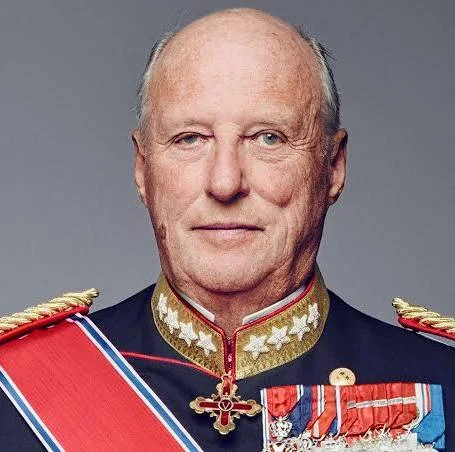
Harald V (1937-2026) King of Norway
Full name: Harald V
Born: February 21, 1937, Skaugum, Asker, Norway
Died: August 28, 2026 (aged 89), Rikshospitalet, Oslo, Norway
Cause of death: Complications from hemolytic anemia and bloodstream infection
Burial: Royal Mausoleum, Akershus Castle and Fortress, Oslo, Oslo kommune, Oslo fylke, Norway
Occupation: King of Norway
Reign: January 17, 1991 – August 28, 2026
Predecessor: Olav V
Successor: Haakon VIII
Spouse: Sonja Haraldsen (m. 1968)
Children: 2 (Princess Märtha Louise and Haakon VIII)
House: Glücksburg
Religion: Church of Norway
Who Was Harald V?
Harald V was King of Norway from 1991 until his death in 2026. He was the first Norwegian-born monarch to inherit the throne since Olav IV in 1380, a gap of 604 years. During his 35-year reign, he became one of the most beloved figures in Norwegian history and was popularly known as the "grandfather of the nation."
Born in Skaugum, Asker, during the reign of his grandfather King Haakon VII, Harald was the third child and only son of Crown Prince Olav and Crown Princess Märtha. He spent part of his childhood in exile in Sweden and the United States during World War II before returning to Norway in 1945. He went on to study at the University of Oslo, the Norwegian Military Academy, and Balliol College, Oxford.
He died on August 28, 2026, at the age of 89, at Rikshospitalet in Oslo. His death was reported by the BBC, Reuters, The New York Times, The Guardian, and other major outlets. His state funeral was held on September 9, 2026, and he was buried at the Royal Mausoleum at Akershus Castle and Fortress in Oslo.
Harald V Cause of Death
Harald V died at 06:35 (UTC+2) on August 28, 2026, at Rikshospitalet in Oslo, at the age of 89. He had been admitted to the hospital on August 17, 2026, with fluid retention caused by cortisone treatment for hemolytic anemia. His condition worsened over the following days.
On August 24, the palace announced that his condition had worsened and that he was receiving antibiotics for a bloodstream infection. On August 27, the palace announced that his condition had become "extremely serious," with family members visiting the hospital to be by his bedside. He died the next morning.
His death was reported by the BBC, Reuters, The New York Times, The Guardian, and other major outlets. On the evening of August 28, when Harald's coffin was taken from the National Hospital to the Royal Palace, more than an estimated 10,000 people lined the streets of Oslo with flowers, Norwegian flags, and cards. It was a powerful display of the affection that the Norwegian people had for their king.
His state funeral was held in Oslo on September 9, 2026. Tens of thousands of people lined the streets as Norway bid farewell to King Harald V. He was buried at the Royal Mausoleum at Akershus Castle and Fortress in Oslo.
Early Life and Education
Harald was born on February 21, 1937, at the Skaugum estate during the reign of his grandfather, King Haakon VII. His parents were Crown Prince Olav (later Olav V) and Princess Märtha of Sweden. He had two older sisters, Princess Ragnhild and Princess Astrid. He was baptised in the Royal Chapel of the Royal Palace in Oslo on March 31 by bishop Johan Lunde.
At the time of his birth, he was second in the line of succession to the Norwegian throne, after his father. He was born into a Europe that was on the brink of war, and his childhood would be shaped by the events that followed.
Second World War
In 1940, the entire royal family fled Oslo because of the German invasion. It was deemed safer for the family to split up. The King and Olav remained in Norway, and Märtha made her way to Sweden with Ragnhild, Astrid, and Harald. They reached Sweden on the night of April 10, but they encountered problems at the border station. According to Astrid and others who were present, they were admitted only after the driver threatened to ram the border gate.
Harald spent the following days in Sälen before moving to his maternal uncle Prince Carl Bernadotte's home in Frötuna on April 16. On April 26, the group moved to Drottningholm in Stockholm. After the King and Olav had to leave Norway on June 7, they felt Sweden might not be the best place for the rest of the family and began planning for them to go to the United States. On August 17, Märtha and her children left for the United States from Petsamo, Finland, aboard the United States Army transport ship American Legion.
Harald, his mother, and his sisters lived in Washington, D.C., during the war, while his father and grandfather stayed in London with the Norwegian government-in-exile. One of the notable events he remembered from that time is standing behind Franklin D. Roosevelt when he was sworn in for his fourth term on the South Portico of the White House in 1945. Such childhood experiences were reflected in a trace of an American accent when he spoke English.
Harald visited Norwegian servicemen training in the United States. He also made visits outside the United States, travelling north to visit Norwegian personnel at the training base Little Norway in Ontario, Canada. He attended The White Hall Country School from 1943 with his sisters. Harald returned to Norway with his family after the war's end in 1945.
Return to Norway
In the autumn of 1945, Harald was enrolled at Smestad School. He was confirmed in May 1953 by bishop Eivind Berggrav at Slottskapellet, the royal chapel. Harald's mother died in 1954, and his maternal grandmother in 1958. These losses shaped the young prince's character and prepared him for the responsibilities that lay ahead.
Crown Prince
Harald studied at Oslo katedralskole from 1950 to 1955. He attended Befalsskolen for kavaleriet at Trandum from January 1956 to May 1957 and studied at the Norwegian Military Academy from 1957 to 1959. On the death of his grandfather on September 21, 1957, Harald became crown prince at the age of 20. He attended the Council of State for the first time on September 27.
Harald reached the age of majority on February 21, 1958, when he became 21, and took the oath to the Constitution of Norway on the same day. In March, he served as regent in the King's absence for the first time.
In 1960, Harald entered Balliol College, Oxford, where he studied history, economics, and politics. He was a keen rower during his student days and was taught by fellow student and friend Nick Bevan, later a leading British school rowing coach. In 1960, he also made his first official journey abroad, visiting the United States for the 50th anniversary of the American Scandinavian Foundation.
An avid sailor, Harald represented Norway in the yachting events of the Summer Olympics in Tokyo in 1964, Mexico City in 1968, and Munich in 1972. He carried the Norwegian flag at the 1964 Games.
Marriage
Harald married Sonja Haraldsen at Oslo Domkirke in Oslo on August 29, 1968. The pair had dated for nine years, but Olav was reluctant to allow his son to marry a commoner. He relented only when Harald told his father that if he was not allowed to marry Sonja, he would not marry at all. The couple had two children, Princess Märtha Louise (born 1971) and Haakon (born 1973).
Reign
On the death of his father on January 17, 1991, Harald succeeded to the Norwegian throne. He became the first Norwegian-born monarch since Olav IV died in 1387, a gap of 604 years. Harald was the sixth King of Norway to bear that name and the first in 855 years. He chose to use his grandfather and father's royal motto, "Alt for Norge" (Everything for Norway). He also chose to continue the tradition of royal benediction, introduced with his father, and was consecrated with Queen Sonja in the Nidaros Cathedral on June 23, 1991.
Harald's reign was marked by modernisation and reform for the Norwegian Royal family. The King cooperated closely with Queen Sonja and Haakon in making the royal household more open to the Norwegian public and the Norwegian media. Harald's decision to accept two more commoners into the royal family, Mette-Marit Tjessem Høiby and Ari Behn, was interpreted as a sign of modernisation and adjustment. Under Harald and Sonja's leadership, comprehensive renovation projects took place at the Bygdøy Royal Estate, the Royal Palace, the royal stables, and Oscarshall. The latter three were also opened to the public.
Constitutional Role
Although the Constitution of Norway vested the King with executive authority, Harald exercised it only in accordance with parliamentary conventions established since 1884. His acts required the countersignature of a member of the Council of State, usually the prime minister, and the Council's proceedings were signed by all ministers. Since 1905, no Norwegian monarch has refused assent to an act of the Storting.
By convention, Harald appointed as prime minister the leader of the parliamentary bloc able to command a majority in the Storting. When the parliamentary situation was unclear, he relied on the advice of the President of the Storting and the sitting prime minister. Unlike many constitutional monarchs, he did not have the power to dissolve Parliament, as the Constitution does not allow for snap elections.
The King met the Council of State at the Royal Palace every Friday. He also had weekly meetings with the Prime Minister and the Minister of Foreign Affairs. He received foreign envoys and formally opened parliament every October, delivering a speech from the throne during each opening. Harald travelled extensively throughout Norway and made official state visits to other countries, as well as receiving and hosting guests.
Until a constitutional amendment in 2012, the King of Norway was the formal head of the Church of Norway. Harald wished that the monarch still be required by the constitution to be of Evangelical-Lutheran faith, which the parliament accepted. On May 8, 2018, the King's constitutional status as holy was dissolved, while leaving his sovereign immunity intact.
1990s and 2000s
In 1994, both the King and Haakon played roles during the opening ceremony of the 1994 Winter Olympics in Lillehammer. Harald opened the games, while Haakon lit the cauldron. In 1997, Harald apologized to the Sámi people for the government trying to erase their culture for over two centuries. It was a significant moment of reconciliation that was widely praised.
2010s
In 2015, Harald became the world's first reigning monarch to visit Antarctica, specifically the Norwegian dependency Queen Maud Land. In 2016, in a speech marking 25 years on the throne, Harald sought to unify Norwegians on religious tolerance, diversity, and LGBTQ rights, saying: "Norwegians are girls who love girls, boys who love boys, and girls and boys who love each other. Norwegians believe in God, Allah, the Universe and nothing. In other words, Norway is you."
When the King and Queen turned 80 years old in 2017, Harald decided to open the former royal stables to the public as a gift to his wife. The new venue was named The Queen Sonja Art Stable and is the first institution owned by the royal family which is permanently open to the public. Harald was named Name of the Year by the newspaper VG in 2017.
2020s
On January 17, 2021, Harald celebrated 30 years on the Norwegian throne. On September 11, 2022, he visited Denmark to celebrate the Golden Jubilee of Margrethe II. On September 15, 2023, he attended the celebrations of the Golden Jubilee of Carl XVI Gustaf in Stockholm, Sweden. Since the death of Elizabeth II in 2022, Harald had been Europe's oldest hereditary reigning monarch, at the age of 89.
During periods when Harald was unable to perform his duties as sovereign, Haakon served as regent. Despite his health issues, Harald never considered abdicating. Following the announcement of the impending abdication of his Danish counterpart Margrethe II, he told the press, "No, I don't really have a plan to abdicate. I stand by what I have said all along. I have taken an oath to the Storting, and it lasts for life."
Health and Death
Harald experienced several periods of ill health following the start of the twenty-first century. He was diagnosed with bladder cancer in 2003, and in 2005, he underwent heart surgery. In 2020, he underwent another heart surgery to replace a heart valve.
He had a leg operation in January 2022. Harald was hospitalised in August with a fever and again in December for an infection, and was admitted once more in May 2023, shortly before Constitution Day. Harald contracted COVID-19 in March 2022 and again in October 2023. In January 2024, the royal palace announced that he was on sick leave due to a respiratory infection.
While on holiday in Malaysia in February 2024, Harald was hospitalised on Langkawi with a low heart rate and had a temporary pacemaker implanted. He was discharged on March 3 and returned to Norway on a medical evacuation flight, after which he was placed on two weeks' sick leave. He received a permanent pacemaker on March 12 and was discharged two days later.
In February 2026, he was hospitalised during a vacation in Tenerife and treated for a skin infection on his leg. On August 17, 2026, Harald was admitted to Oslo University Hospital, Rikshospitalet with fluid retention caused by cortisone treatment for hemolytic anemia and was placed on two weeks' sick leave. On August 24, the palace announced that his condition had worsened and that he was receiving antibiotics for a bloodstream infection. On August 27, the palace announced that his condition had become "extremely serious," with family members visiting the hospital to be by his bedside. Harald died at 06:35 (UTC+2) on August 28, aged 89.
Public Image
Harald's leadership during Norwegian national crises, such as the New Year's Day Storm in 1992, the July 2011 massacre, the 2020 Gjerdrum landslide, and particularly the COVID-19 pandemic from January 2020 to March 2022, was met with both national and international acclaim. He was popularly known among the Norwegian public as a "grandfather of the nation."
He was also known for being humble, down-to-earth, and for his sense of humour, as well as his use of informal language with somewhat archaic pronunciations. He was an outdoorsman who participated in skiing, hunting, and fishing. Harald described his life in Norway as "normal," attending movies, travelling without paparazzi surrounding him, and wearing casual attire while sailing, with citizens who were equally laid back about having a monarchy.
Harald was an environmentalist, acting as an initiator of the Norwegian branch of the World Wide Fund for Nature and held the title of president of the Norwegian chapter for 20 years. He went to visit the Amazon region in 2013.
In 2014, he sparked media interest when in a TV interview, as he was talking about his planned visit to the Antarctic research station Troll, Harald joked that it was named after his wife Sonja. In 2020, Harald invited and received hurdler and sprinter Karsten Warholm along with his coach Leif Olav Alnes for an informal conversation at Bygdøy Royal Estate, which was documented by NRK. Warholm was widely criticized by the public and the media for wearing shorts, considered to be "disrespectful" when meeting a reigning monarch. In contrast to public opinion, Harald laughed it off the moment he noticed it and commented "You are lucky, short trousers!" as the weather was exceptionally hot.
In 2025, Amazon Prime Video released the period drama The Commoner, which tells the story of the fight of then Crown Prince Harald and Sonja Haraldsen for their right to marry. Harald is portrayed by Sindre Strand Offerdal.
Sports Career
Harald was engaged in sailing and participated in the Olympics in 1964 and 1968 in the 5.5 Metre class, and in 1972 in the Soling class. With his sailing crew, he won World Championship medals including gold in 1987 and bronze in 1988, both in the One Ton class, and silver in 1982.
In July 2005, Harald and his crew aboard the royal sailboat Fram XV won the gold medal at the European Championships in Sweden. In the 2007 World Championship, the King came in sixth place. In 2016, Harald competed with a team at the sailing World Championships on Lake Ontario in Toronto, finishing second in the classic fleet category. He was dubbed a "sailor king" by Canada's National Post as he slept on board his yacht Sira. In 2018 he placed third at the World Championships and in 2022 finished 10th in the 8 Metre World Championship.
Harald was the first president of the Norwegian Sailing Federation when it was founded in 1970 and became the President of Honour for World Sailing in 1994, succeeding his father. He also organized the inclusion of sailing under the purview of the Norwegian Olympic and Paralympic Committee and Confederation of Sports and participated in the organization of the 1994 Winter Olympics in Lillehammer.
Honours and Medals
Harald V was a four-star general, an admiral, and formally the Supreme Commander of the Norwegian Armed Forces. The infantry battalion His Majesty the King's Guard are considered the monarch and the Royal Family's bodyguards.
National Honours and Medals
Harald received numerous Norwegian honours, including the Grand Cross with Collar of the Royal Norwegian Order of Saint Olav, the Grand Cross of the Royal Norwegian Order of Merit, and the Defence Service Medal with Laurel Branch. He also received various commemorative medals related to the reigns of his grandfather and father.
Foreign Honours
Harald received honours from numerous foreign countries. In the British Army, he was appointed an honorary general in 1994, and he was the final Colonel-in-Chief of the Green Howards. He was also an honorary Colonel in the British Royal Marines. He was a Stranger Knight Companion of the Order of the Garter, an Honorary Knight Grand Cross of the Royal Victorian Order, and a recipient of the Royal Victorian Chain, as well as numerous other orders of chivalry.
He received honours from Northern European countries including Denmark, Estonia, Finland, Iceland, Latvia, Lithuania, Sweden, and the United Kingdom. He also received honours from many other countries around the world, including Austria, Belgium, Brazil, Bulgaria, Chile, Croatia, France, Germany, Greece, Hungary, Italy, Japan, Jordan, Luxembourg, the Netherlands, Poland, Portugal, Romania, Slovakia, Slovenia, Spain, South Africa, South Korea, Thailand, Turkey, and Yugoslavia.
Issue
Harald V and Queen Sonja had two children and several grandchildren.
| Name | Birth | Marriage | Children |
|---|---|---|---|
| Princess Märtha Louise | September 22, 1971 | Ari Behn (m. 2002; div. 2017) Durek Verrett (m. 2024) |
Maud Angelica Behn, Leah Isadora Behn, Emma Tallulah Behn |
| Haakon VIII | July 20, 1973 | Mette-Marit Tjessem Høiby (m. 2001) | Crown Princess Ingrid Alexandra, Prince Sverre Magnus |
Tributes and Legacy
Following the announcement of Harald V's death, tributes poured in from across the world. King Charles, Queen Margrethe II of Denmark, President Emmanuel Macron of France, Chancellor Angela Merkel of Germany, and other world leaders expressed their condolences to the Norwegian people.
His death was covered extensively by international media. The BBC, Reuters, The New York Times, The Guardian, and other major outlets published obituaries celebrating his life and reign. He was remembered as a unifying figure who had guided Norway through difficult times with dignity, humility, and grace.
Harald V's legacy is one of stability, modernity, and service. During his 35-year reign, he modernised the Norwegian monarchy, made the royal household more open to the public, and accepted commoners into the royal family. He was a unifying figure during national crises and a symbol of Norwegian resilience. He was also a celebrated athlete who represented his country at the Olympics. He was known for his humility, his sense of humour, and his deep love for Norway and its people.
Frequently Asked Questions: Harald V
Who was Harald V?
Harald V (February 21, 1937 – August 28, 2026) was King of Norway from 1991 until his death in 2026. He was the first Norwegian-born monarch to inherit the throne since Olav IV in 1380. He was widely known as the "grandfather of the nation" for his leadership during national crises and his humble, down-to-earth personality.
How did Harald V die?
Harald V died at 06:35 (UTC+2) on August 28, 2026 at Rikshospitalet in Oslo, at the age of 89. He had been admitted to the hospital on August 17, 2026, with fluid retention caused by cortisone treatment for hemolytic anemia. His condition worsened in the following days, and the palace announced on August 27 that his condition had become "extremely serious." He died the next morning.
What was Harald V's cause of death?
Harald V died from complications related to hemolytic anemia and a bloodstream infection. He had been admitted to Rikshospitalet in Oslo on August 17, 2026, with fluid retention caused by cortisone treatment for hemolytic anemia. On August 24, the palace announced that he was receiving antibiotics for a bloodstream infection. His condition became "extremely serious" on August 27, and he died on the morning of August 28, 2026, at the age of 89.
Where was Harald V buried?
Harald V was buried at the Royal Mausoleum at Akershus Castle and Fortress in Oslo, Oslo kommune, Oslo fylke, Norway. His state funeral was held in Oslo on September 9, 2026, and he was laid to rest at the Royal Mausoleum at Akershus Fortress, the traditional burial site of Norwegian monarchs.
When was Harald V's funeral?
Harald V's state funeral was held in Oslo on September 9, 2026. On the evening of August 28, when Harald's coffin was taken from the National Hospital to the Royal Palace, more than an estimated 10,000 people lined the streets of Oslo with flowers, Norwegian flags, and cards. Tens of thousands more lined the streets on the day of the funeral to bid farewell to their beloved king.
What was Harald V famous for?
Harald V was famous for being the King of Norway for 35 years, from 1991 until his death in 2026. He was the first Norwegian-born monarch to inherit the throne since Olav IV in 1380. He was also an accomplished sailor who represented Norway in three Olympic Games and won world championship medals in sailing. He was known as the "grandfather of the nation" for his leadership during national crises.
Where was Harald V born?
Harald V was born on February 21, 1937 at the Skaugum estate in Asker, Norway, during the reign of his paternal grandfather, King Haakon VII. He was the third child and only son of Crown Prince Olav (later King Olav V) and Crown Princess Märtha of Norway.
Did Harald V fight in World War II?
Harald V was only three years old when Germany invaded Norway in 1940. He fled Norway with his mother and sisters, first to Sweden and then to the United States, where they lived in Washington, D.C., during the war. His father and grandfather stayed in London with the Norwegian government-in-exile. Harald returned to Norway with his family after the war ended in 1945.
What was Harald V's education?
Harald V studied at Oslo katedralskole from 1950 to 1955. He attended Befalsskolen for kavaleriet at Trandum from January 1956 to May 1957 and studied at the Norwegian Military Academy from 1957 to 1959. In 1960, he entered Balliol College, Oxford, where he studied history, economics, and politics.
When did Harald V become king?
Harald V became King of Norway on January 17, 1991, following the death of his father, King Olav V. He was consecrated with Queen Sonja in the Nidaros Cathedral on June 23, 1991. He reigned for 35 years, until his death on August 28, 2026.
Who was Harald V's wife?
Harald V married Sonja Haraldsen at Oslo Domkirke in Oslo on August 29, 1968. The pair had dated for nine years, but Olav was reluctant to allow his son to marry a commoner. He relented only when Harald told his father that if he was not allowed to marry Sonja he would not marry at all. They had two children, Princess Märtha Louise and Haakon.
Who are Harald V's children?
Harald V and Queen Sonja had two children: Princess Märtha Louise (born September 22, 1971) and Haakon VIII (born July 20, 1973). Princess Märtha Louise was married to Ari Behn from 2002 to 2017 and later married Durek Verrett in 2024. Haakon VIII married Mette-Marit Tjessem Høiby in 2001 and succeeded his father as King of Norway.
Who succeeded Harald V as King of Norway?
Harald V was succeeded by his son, Haakon VIII, who became King of Norway upon his father's death on August 28, 2026. During periods when Harald was unable to perform his duties as sovereign, Haakon served as regent several times between 2003 and 2026.
What was Harald V's sports career?
Harald V was an accomplished sailor who represented Norway in the Olympic Games in 1964, 1968, and 1972. He carried the Norwegian flag at the 1964 Games. With his sailing crew, he won World Championship medals including gold in 1987 and bronze in 1988, both in the One Ton class, and silver in 1982. In July 2005, he won the gold medal at the European Championships in Sweden.
What was Harald V's health like in his final years?
Harald V experienced several periods of ill health in his final years. He was diagnosed with bladder cancer in 2003 and underwent heart surgery in 2005 and again in 2020. He had a leg operation in January 2022 and was hospitalised multiple times for infections. In February 2024, while on holiday in Malaysia, he was hospitalised with a low heart rate and received a temporary pacemaker, followed by a permanent one in March 2024. In February 2026, he was treated for a skin infection on his leg during a vacation in Tenerife. His final illness began in August 2026.
What was Harald V's net worth?
There is no reliable, publicly verified estimate of Harald V's personal net worth. The Norwegian royal family's finances are managed through the royal court and the state budget. The King received an annual allowance from the Norwegian government, and the royal properties are held in trust for the nation. His personal wealth has never been officially disclosed.
Why was Harald V called the 'grandfather of the nation'?
Harald V was popularly known as the "grandfather of the nation" (nasjonens bestefar) because of his leadership during major Norwegian national crises. His presence and words during events such as the 1992 New Year's Day Storm, the 2011 Norway attacks, the 2020 Gjerdrum landslide, and the COVID-19 pandemic earned him widespread acclaim both domestically and internationally. His humble, down-to-earth personality and his sense of humour also endeared him to the Norwegian people.
What was Harald V's connection to the British royal family?
Harald V was in the line of succession to the British throne because of his descent from King Edward VII. He was a Stranger Knight Companion of the Order of the Garter, an Honorary Knight Grand Cross of the Royal Victorian Order, and a recipient of the Royal Victorian Chain. In the British Army, he was appointed an honorary general in 1994 and was the final Colonel-in-Chief of the Green Howards. He was also an honorary Colonel in the British Royal Marines.
What was Harald V's legacy?
Harald V's legacy is one of stability, modernity, and service. During his 35-year reign, he modernised the Norwegian monarchy, made the royal household more open to the public, and accepted commoners into the royal family. He was a unifying figure during national crises and a symbol of Norwegian resilience. He was also a celebrated athlete who represented his country at the Olympics. He was known for his humility, his sense of humour, and his deep love for Norway and its people.
Contents
- Who Was Harald V
- Cause of Death
- Early Life and Education
- Crown Prince
- Reign
- Health and Death
- Public Image
- Sports Career
- Honours and Medals
- Issue
- Tributes and Legacy
- FAQs (19+ Questions)
Data Update
Based on BBC News, Reuters, The New York Times, The Guardian, The Times, Tatler, and Wikipedia. Information about his death may change as more details become available.